ABOUT
About this spot
Shuzenji Onsen is a hot spring town in Shuzenji, Izu City, Shizuoka Prefecture. It is regarded as the oldest hot spring on the Izu Peninsula and is among the "100 Famous Hot Springs of Japan." The water is an alkaline simple spring. The Shuzenji River, popularly called the Katsura River, runs through the center of the town, with inns and restaurants along its banks.
The spring's opening goes back to the Heian period, the time when Kobo Daishi (Kukai) is said to have founded Shuzenji Temple. According to legend, Kobo Daishi saw a boy washing his father's body on the riverbank and broke a rock with his vajra (dokko), and hot water gushed out. The Tokko-no-yu, a footbath in a small pavilion in the middle of the river, is the symbol of the town.
Shuzenji Temple, at the heart of the town, is an old temple said to have been founded by Kukai in 807 and is now a Soto Zen temple. In the Kamakura period Minamoto no Noriyori and Minamoto no Yoriie are said to have been confined here and to have died here. The principal image, a wooden seated Dainichi Nyorai, is a nationally designated Important Cultural Property, and an ink inscription found inside says it was made by Jikkei in 1210. In addition, a volume of the Song-edition Hoko Hannya Kyo, with a note said to be in the hand of Hojo Masako, is a prefectural tangible cultural property of Shizuoka, and the Katsura tree in the precinct is a prefectural natural monument. The present main hall was rebuilt in 1883.
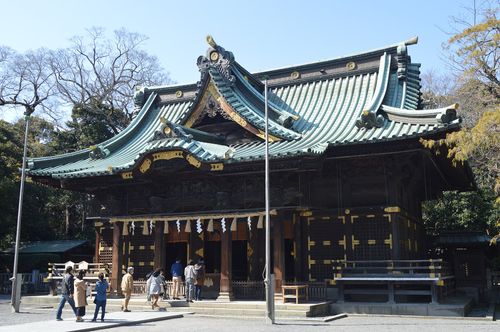
Genji Park holds Shigetsuden, said to have been built by Hojo Masako to pray for Yoriie's repose, and regarded as the oldest wooden building in Izu. There are also Yoriie's grave and the graves of the thirteen men (Jusanshi). Hie Shrine stands on the site of Shinko-in, where Minamoto no Noriyori was confined, Noriyori's grave is also among the town's sights.
Shuzenji Onsen was loved by writers. In the Meiji period Natsume Soseki came to recover here and fell into a coma for a time in the so-called "Shuzenji illness," which he described in "Omoidasu Koto Nado." Okamoto Kido's play "Shuzenji Monogatari" takes Yoriie's tragedy as its subject, Ozaki Koyo wrote "Konjiki Yasha" here, and works by Izumi Kyoka, Shimazaki Toson, Tayama Katai, Kawabata Yasunari, Ibuse Masuji, and Akutagawa Ryunosuke are also connected to Shuzenji.
It is a pleasant town to walk. The promenade called the Bamboo Grove Path is popular for strolls through the hot spring town. There are seven public baths in town, and in 2002 Hakoyu opened, a bath that visitors can also use. The hot water has been supplied under centralized management since June 1981. Before that, unregulated pumping let seawater mix in and reduced the minerals, and efforts to protect the resource have continued.
Beyond the center are the Orthodox Church of Hristos, a prefectural tangible cultural property of Shizuoka, and Shuzenji Niji-no-Sato, where you can learn about British history and culture. A riverside hot spring town, a temple and park that preserve history, and the footsteps of writers can all be followed in turn on foot.
Sources
This article was written from the official, municipal and tourism-association sources above, and checked against them separately from the writing. Editorial policy
Last updated November 12, 2026