ABOUT
About this spot
A lake formed by spring water, spreading from Higashi Ward into Chuo Ward in Kumamoto. National Route 57 (the Kumamoto Higashi Bypass) divides it into Kami-Ezuko (Upper Ezu) and Shimo-Ezuko (Lower Ezu), and although surrounded by residential neighborhoods it is richly green and serves as a place of relaxation for residents. It is the largest spring-fed pond in Kumamoto City, regarded by the city as a symbol of its environment; about 600 species of plants and animals live here, and it has been selected as one of the Ministry of the Environment's "Important Wetlands of Japan."
This area was a wetland where people lived from ancient times, and the Naeshirozu site lies on the bed of Shimo-Ezuko. In the Nara period a provincial capital was placed to the west and the land dried out further; later, in the Keicho era, Kato Kiyomasa built the Ezu embankment, and the welling water collected to take the form of a lake. There was a period when water quality worsened because of factory wastewater and housing development, but purification efforts are now under way. The surroundings were developed as Suizenji Ezuko Park in 1966.
The lake's charm lies in its stable water temperature and its abundance of life. The water stays at 19-20 degrees Celsius all year, aquatic plants are abundant, and 28 species of purely freshwater fish alone have been recorded. Plants from northern to southern types can be seen, and rare species such as suizenjinori (an edible freshwater alga) live here. Herons, ducks and migratory birds visit in large numbers. On the other hand, invasive species such as largemouth bass have increased, and Kumamoto City has set an ordinance and is carrying out their removal.
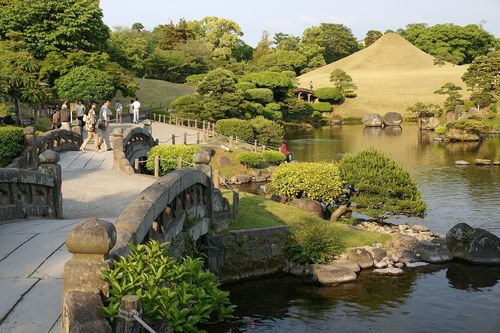
There are many ways to enjoy it. Kami-Ezuko has an island called Nakanoshima, and Bridges No. 1 to No. 4 let you cross between the left and right banks. On the right bank there are privately run boat rental shops where you can row out onto the water. Shimo-Ezuko has a 1,000-meter rowing course used by university and high school rowing clubs for practice. A walking path runs from Suizenji Jojuen Garden to the southern end of Shimo-Ezuko, so you can walk around the waterside. The lake has long been loved for playing in the water and fishing.
Nearby are Kumamoto City Zoological and Botanical Gardens, built on land partly reclaimed from Shimo-Ezuko, as well as Kumamoto Prefectural Library and Shoguchi Park, which can be combined with a walk. The Kumamoto streetcar is convenient: "Kamizui Intersection" is closest to Kami-Ezuko, and "Dobutsuen-iriguchi" is closest to Shimo-Ezuko from the zoo side. A large parking lot is available in the Hiroki area. Together with Suizenji Jojuen Garden, you can build a half-day itinerary touching Kumamoto's spring water.
Sources
This article was written from the official, municipal and tourism-association sources above, and checked against them separately from the writing. Editorial policy
Last updated November 15, 2026