ABOUT
About this spot
Atami Onsen is a hot spring resort in Atami City, Shizuoka Prefecture. Most of the water is sodium-calcium chloride spring water, with a high sulfate content and weak alkalinity, and it is said to be characterized by a smooth feel on the skin. Atami is unusual in Japan in that the city itself runs the hot spring business, supplying hot spring water to inns and company retreats as well as to ordinary households.
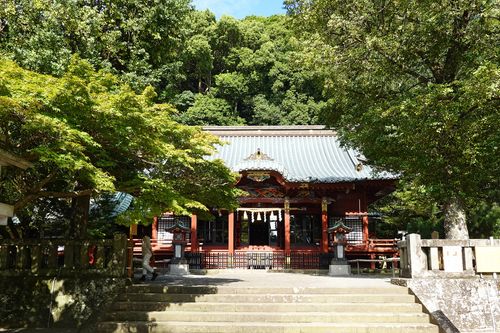
The history is long. The Izu Fudoki of 713 describes a 'divine spring' that boiled violently and gushed twice in a day and night, which is said to refer to the Oyu Geyser. According to Atami City's guide, a chronicle records the origin of Atami Onsen as follows: in 749 the monk Mangan Shonin of Hakone Gongen moved the vein of a hot spring that was welling up in the sea to the present site of Oyu, and built Yuzen Shrine there as its guardian. Tokugawa Ieyasu is recorded as visiting Atami for a hot-spring cure in 1604 (Keicho 9), and afterwards the hot spring water was also carried to Edo Castle, a practice called Okumiyu.
The Oyu Geyser was once a naturally erupting spring that is said to have gushed so violently, several times a day and night, that the ground seemed to shake. When springs were developed around it in the Meiji era the eruptions weakened and stopped from time to time, so in 1962 work was done to make it spout artificially. In 1977 it became a designated cultural property of Atami City as 'Atami Nanayu: Oyu', and today it is made to spout artificially to recall its former appearance. Yuzen Shrine, a short way up the slope from Oyu, enshrines Yakushi Nyorai and Sukunahikona.
In the Meiji era Atami was known as a 'kingdom of villas', where members of the imperial family, leading figures in politics and business, and writers built second homes. According to the city's guide, a number of hot-spring 'firsts' in Japan are tied to Atami, including the first Western-style hot spring analysis report (1874), the hot-spring recuperation center Kyukikan (1885), and the first imperial villa built at a hot spring resort (1888).
Ozaki Koyo's newspaper novel Konjiki Yasha made the name of Atami known throughout Japan. The Atami coast is said to be the setting of the scene where Hazama Kan'ichi and Omiya part in the story. Next to Omiya no Matsu (Omiya's Pine) in Higashikaigan-cho along National Route 135 stands a statue of Kan'ichi and Omiya, erected in 1986. The first pine was called 'Hagoromo no Matsu', but after Oguri Fuyo set up a monument inscribed with a verse from Konjiki Yasha in 1919 it came to be called Omiya no Matsu, and the present pine is the second one, planted in 1966. You can reach Omiya no Matsu from Atami Station on foot or by bus. Conditions at places such as the Oyu Geyser may change, so please check the information of Atami City or the tourist association before you visit.
Sources
- ja.wikipedia.org
- ja.wikipedia.org
- ja.wikipedia.org
- city.atami.lg.jp
- city.atami.lg.jp
- city.atami.lg.jp
- city.atami.lg.jp
- tabi-mag.jp
This article was written from the official, municipal and tourism-association sources above, and checked against them separately from the writing. Editorial policy
Last updated November 12, 2026