ABOUT
About this spot
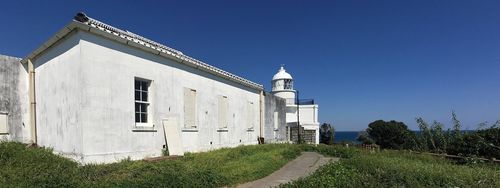
Shionomisaki Lighthouse is a white stone lighthouse standing on Cape Shionomisaki in Kushimoto Town, Wakayama Prefecture. The cape is the southernmost point of Honshu and also of the Kii Peninsula, and a main sightseeing area of Kumano within Yoshino-Kumano National Park and the Nankii Kumano Geopark. Jutting far into the Pacific, it has long been a landmark for ships and also known as a difficult stretch of sea.
The cape was originally an island, but sand and gravel carried by currents formed a sandbar that joined it to the mainland, making it a tombolo, and some count it among Japan's three great tombolos. The top is a flat plateau formed when a sea-cliff terrace was uplifted, 60 to 80 meters above sea level, with cliffs over 40 meters high along the coast. The rock comes from Miocene undersea volcanic activity. The area is also known as a typhoon path: the 1959 Ise Bay Typhoon made landfall on Honshu to the west of the cape.
The lighthouse dates back to the early Meiji era. It is one of eight treaty lighthouses promised under the 1866 tariff convention. Construction began in 1869, and in 1870 an octagonal wooden lighthouse began provisional operation, said to be Japan's first Western-style wooden lighthouse. Delivery of the equipment was delayed when a transport ship sank, and the light was formally lit in 1873. It was rebuilt as the present stone tower in 1878. The design followed specifications from the Stevenson office in Scotland, directed by foreign engineer Richard Henry Brunton, with Arthur Blundell responsible for design and construction.
The tower is white stone, 22.51 meters from ground to top, with the light 49.47 meters above mean sea level. It emits one white flash every 15 seconds, visible about 19 nautical miles (roughly 35 km). It is described as open to the public as a visitable lighthouse where you can climb to the top, and an adjoining exhibition room displays items including the second-generation Fresnel lens. Access can change, so check before you go.
Around the lighthouse there is much to see: the lawn called Boro-no-Shiba (a naval lookout was built on the cape in 1894); rocky shores used for fishing; an observation tower; and a rest area and museum about emigrants who went from Kushimoto to Australia. The cape is introduced as selected for the New 100 Travel Destinations of Japan and the 100 Best Sunsets of Japan.
Reach it by community bus from JR Kushimoto Station on the Kisei Line, or by car along Route 42 and prefectural roads. On windy or stormy days take care when walking on the cape. A clear day is best for feeling the breadth of sea and sky.
Sources
This article was written from the official, municipal and tourism-association sources above, and checked against them separately from the writing. Editorial policy
Last updated November 12, 2026