ABOUT
About this spot
In a valley of the Ii homeland stands a shrine to a prince who fought through the Nanboku-cho period. The enshrined deity is Prince Munenaga, a son of Emperor Go-Daigo who is said to have campaigned across eastern Japan as a commander of the Southern Court. He is also known as a gifted poet, and is said to have died in 1385 (the second year of Genchu) at Iinoya, where he spent his last years. Behind the shrine is the prince's tomb, which is designated by the Imperial Household Agency. While most imperial tombs face south, this one is said to face west, toward the capital, a reminder of his longing for Kyoto.
The shrine's origins go back to the years after the Meiji Restoration. Ii Naonori, the former lord of Hikone Domain, drew attention to the prince's tomb at Iinoya. The valley was also the ancestral home of the Ii family, and a tradition says that members of the family helped the prince during his stay. In 1869 Naonori petitioned for a shrine, and the Meiji Emperor is said to have approved it; in January 1872 the shrine, first called Munenaga-no-Miyashiro, was renamed Iinoya-gu after the place. In 1873 it was ranked a kanpei chusha (middle-rank imperial shrine), and it is described as the only kanpei shrine in Hamamatsu. It is also counted among the Fifteen Shrines of the Kenmu Restoration.
Within the grounds is the sub-shrine Ii-sha, dedicated to Ii Michimasa and Ii Takaaki of the Ii family. That one can still pay respects to the ancestors of the family that supported Prince Munenaga is a scene unique to this shrine. Iinoya is the land of the Ii clan's forebears, and the history of the shrine and the history of the region overlap here. Among its treasures is a long sword inscribed "Kunitsuna," which is designated an Important Cultural Property.
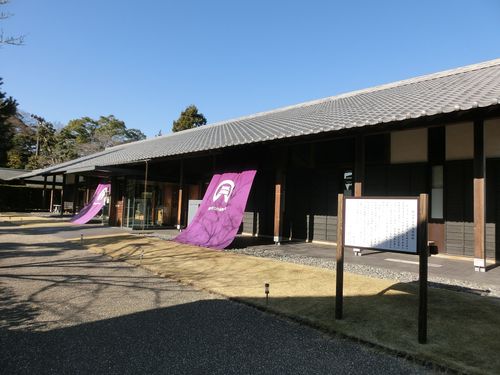
The ema (votive plaque) museum along the approach is another highlight. It is introduced as displaying ema collected from shrines and temples around the country, and through these plaques, a distinctly Japanese form of devotion, you can follow how people's wishes have changed with the times.
The annual festival is held on September 22, timed to the prince's death anniversary. As a shrine to Prince Munenaga, it is said to bring blessings for academic success, exam success and protection from misfortune. It is not a flashy tourist site, but if you walk the grounds at a quiet hour the stillness of the tree-shaded precinct comes through well, making it suitable for a solo trip to historic sites. Allow about an hour for the grounds and the museum together.
By car, the shrine is about 20 minutes from Hamamatsu-Inasa IC on the Shin-Tomei Expressway and about 30 minutes from Hamamatsu-Nishi IC on the Tomei Expressway, with parking (reported as about 150 spaces). By public transport, take an Entetsu bus from Hamamatsu Station and get off at the Jinguji or Ryotanji stop. Ryotan-ji Temple, the family temple of the Ii clan, is nearby, so you can combine sites associated with the Ii family in one walk.
Sources
This article was written from the official, municipal and tourism-association sources above, and checked against them separately from the writing. Editorial policy
Last updated November 16, 2026