ABOUT
About this spot
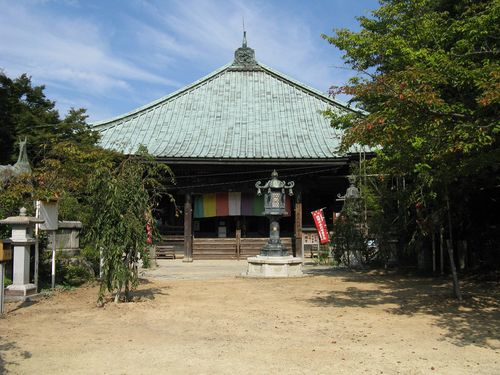
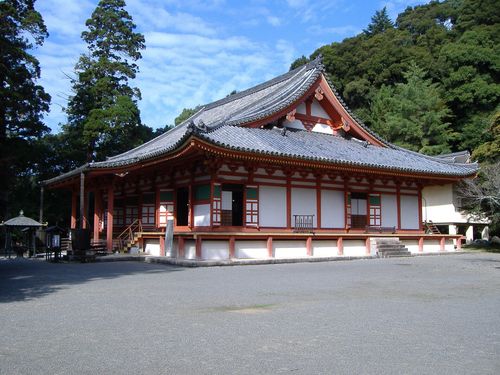
In the hills of Kozumi in Kaizuka, southern Osaka Prefecture, stands a single old hall of simple, restrained design. It is the Kannon-do, the main hall of the Jodo-school temple Koon-ji, known locally as the "Kugi-nashi-do of Kozumi" (the Nail-less Hall), and it is designated a National Treasure. The principal image is Amida Nyorai, and the temple's mountain name is Jigen-zan.
The hall's history goes back to Kannon-ji, a temple older than Koon-ji itself. Tradition says the priest Gyoki founded Kannon-ji in 726, and it is counted among his "Forty-nine Temples." The place name Kozumi is also said to come from the timber Gyoki had cut in the mountains and gathered here when building his temples. Most of the buildings were lost in the wars of the Muromachi period and again in 1585, when Toyotomi (then Hashiba) Hideyoshi's campaign against Kii destroyed the compound. The Kannon-do was the only structure left standing. A story still told locally says that the statues were sunk in Yakushi Pond to save them from the fire. Kannon-ji was abolished in 1889, merged into Koon-ji in 1914, and the Kannon-do became Koon-ji's main hall.
The present building is a late Kamakura-period reconstruction and is regarded as the oldest wooden building in Osaka Prefecture. It is a single-story hip-roofed hall, five bays by five bays, with an unusual "Gyoki-buki" tile roof. The basic design is in the Japanese Wayo style, with lattice windows and parallel rafters, but the heavy use of horizontal tie beams (nuki) in place of nageshi, and the paneled front doors, show touches of the Zen style. Inside, the round-section beams spanning the outer chamber are in the Daibutsu style. Several styles meet in one hall, which is a highlight for anyone interested in architecture. The "nail-less" nickname is not unique to this hall, since traditional joinery in temples and shrines generally avoids nails in the structure. Even so, the restrained design, in which the brackets and rafters themselves make up the decoration, is well worth a look.
The hall was dismantled and repaired in 1916, and a conservation project followed, running from September 2019 to July 2022. It covered the roof tiles and the plaster walls, and the work turned up inscribed tiles from the Muromachi period and ridge tablets (munafuda) from the Edo period.
The temple's cultural property storehouse shelters Heian-period statues from a group of 19 Important Cultural Property designations (one, the standing Kokuzo Bosatsu, is on deposit at the Osaka City Museum of Fine Arts). They include the Amida triad (a seated Amida Nyorai flanked by two standing Eleven-headed Kannon), plus a seated Shaka Nyorai, a standing Yakushi Nyorai, Taishakuten and Tamonten. The statues in the storehouse are shown only during special viewings of about ten days around the spring and autumn equinoxes. Check the Kaizuka City announcement for dates and how to apply before you go.
Bright daytime hours, when the roofline is easiest to see, suit a visit best. The grounds are small, so allow roughly 30 minutes to an hour to take in the hall. The temple is Temple No. 25 of the Izumi Saigoku 33 Kannon Pilgrimage, and some visitors combine it with the neighboring Joganji (No. 24) and Mizuma-dera (No. 26). By public transport, take the Mizuma Railway to Mizuma-Kannon Station and then a Suitetsu bus to the Kuginashi-do stop.
Sources
This article was written from the official, municipal and tourism-association sources above, and checked against them separately from the writing. Editorial policy
Last updated November 16, 2026