ABOUT
About this spot
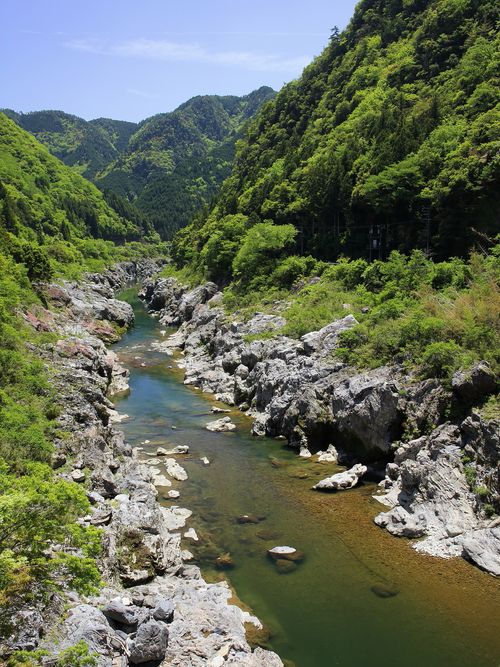
Gero Onsen is a hot spring that wells up along the Hida River in Gero, Gifu Prefecture. It was introduced as a famous bath, together with Kusatsu and Arima, by the Muromachi-period monk Banri Shuku, and the Edo-period Confucian scholar Hayashi Razan likewise ranked it with Arima and Kusatsu among the three famous springs.
The water is a colorless, transparent alkaline simple spring with a pH of 9 or higher. Its smooth feel on the skin has earned it the nickname "beauty water." Water from several sources is blended and sent to each inn at about 55 degrees, and inns and hotels line the river banks.
The spring is said to have been found in the middle of the Heian period, when hot water began to flow near the summit of Mt. Yugamine (1,067 meters), about 4 kilometers from the hot spring town; some say it was in the Tenryaku era (947-957), others in the Engi era (901-923). When the flow near the summit stopped in 1265, hot water was found on the gravel bed of the Hida River; with the source now on level ground, the spring became easier to use and its fame spread. This rediscovery is tied to the White Egret Legend, in which Yakushi Nyorai took the form of a white egret to show villagers where the water flowed. The image of Yakushi Nyorai that had been enshrined on Mt. Yugamine was moved to the village and made into a temple, Onsen-ji; the present temple stands at the foot of Mt. Nakane and is said to have been founded in 1671 in the Edo period. The place name Gero is said to derive from the post station Shimotomari recorded in the Shoku Nihongi, whose Chinese-style reading changed into Gero. The spring later declined after the great Ansei flood damaged its veins, but drilling began in the Taisho era, and in 1931 the Yunoshimakan inn opened; its building is a registered tangible cultural property.
On the riverbed of the Hida River in the center of the hot spring town is the Fountain Pool (Funsenchi). It was set up in 1983 as an open-air bath, but according to the city's guide, bathing there has been prohibited since December 1, 2021, and it is now for footbathing only. There are three public baths, the Kua Garden open-air bath, the White Egret Bath (Shirasagi no Yu) and Sachinoyu, and footbaths are scattered around the town. A "Yumeguri Tegata" bath-hopping pass, sold by the Gero Onsen inn cooperative, lets you bathe at three of the member inns. Other sights include the Gero Hot Spring Museum, Gero Onsen Gassho Village, Moriminashi Hachiman Shrine, Kaeru Shrine and Yunomachi Ujo Park. Facility availability can change, so please check official information from Gero City or the tourist association before you visit.
Sources
This article was written from the official, municipal and tourism-association sources above, and checked against them separately from the writing. Editorial policy
Last updated November 12, 2026