ABOUT
About this spot
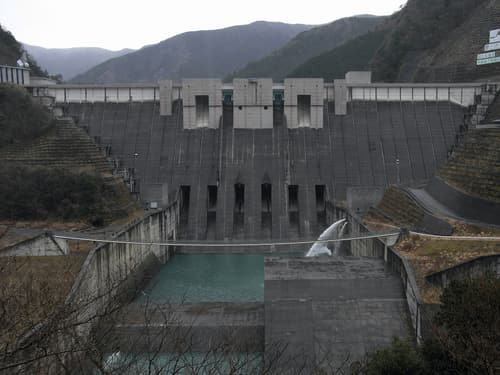
Sakuma Dam stands on the middle reach of the Tenryu River, on the border between Tenryu Ward in Hamamatsu, Shizuoka Prefecture, and Toyone Village in Aichi Prefecture. Managed by J-POWER, it is a concrete gravity dam 155.5 meters high, one of the largest in Japan. Its reservoir, Lake Sakuma, stretches about 33 kilometers, holds about 327 million cubic meters, and has been chosen as one of the Hundred Dam Lakes. The dam body lying across a valley between steep mountains is an impressive sight.
Plans for hydropower on the Tenryu River go back to the water rights obtained by Nagoya Dento in the Taisho era, but nothing was built until after the war. J-POWER was founded in 1952 and took over the plan; work began in 1953 and the dam was completed in 1956. Compensation talks for the houses to be submerged continued until every household agreed, and the Iida Line railway was rerouted. Large American heavy machinery was brought in, and the dam is remembered as a major project of postwar reconstruction. Ninety-six workers died during construction, and the dam body you see today stands on the effort and sacrifice of many people. Looking quietly at the lake and the dam, you can feel the weight of that great project.
Prefectural Route 1 runs across the top of the dam. An observation deck gives a view of the whole dam, and cherry trees are planted around the dam, which look splendid together with the fresh green of spring. Next to the dam, the Sakuma Electric Power Museum shows footage from the construction period and lets you learn about the science of electricity through hands-on exhibits; admission is free. The Sakuma and Shintoyone power stations produce electricity here.
Spring brings cherry blossoms and fresh green, and autumn brings color, which makes them pleasant seasons for a walk by the lake. A festival called the Ryujin Matsuri is held every autumn, and anglers fish for ayu and rainbow trout in the lake. Before you go, check the official site or the tourist association for facilities and road conditions.
A footpath leads from Chubu-Tenryu Station on the JR Iida Line, so you can walk, but there is normally no public transport to the dam, so most visitors come by car. Allow one to two hours around the dam. Akiba Dam, Shintoyone Dam and Misakubo Dam are nearby, and the area is part of Tenryu-Okumikawa Quasi-National Park, so you can combine a dam tour with a drive.
Sources
This article was written from the official, municipal and tourism-association sources above, and checked against them separately from the writing. Editorial policy
Last updated November 21, 2026