ABOUT
About this spot
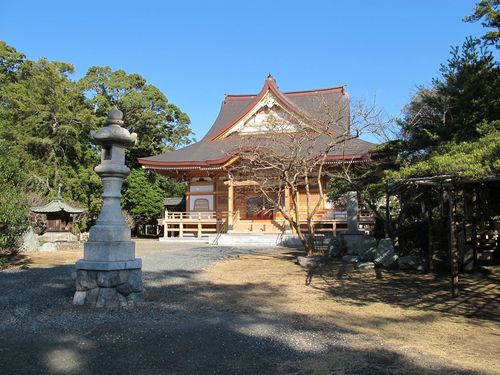
In the mountains of Mt. Kiyosumi in the south of the Boso Peninsula, whose highest peak is Mt. Myoken at 377 m, stands this head temple of the Nichiren school. Its mountain name is Senkozan. The main hall sits at about 310 m above sea level, and the whole precinct lies within Minami-Boso Quasi-National Park. It is said to be the temple where Nichiren was ordained and proclaimed the founding of his school, and together with Kuonji, Ikegami Honmonji and Tanjoji it counts among the four sacred sites of the Nichiren school.
According to the temple's origin story, a wandering monk called Fushigi Hoshi enshrined the bodhisattva Kokuzo here in 771. An old oak near the summit gave off a thousand rays of light, so the mountain was named Senkozan (Mountain of a Thousand Lights), and a dried-up pond beneath the oak is said to have filled with clear spring water after a blessing, giving the temple its name, Seicho-ji (Clear Water). Ennin (Jikaku Daishi) revived it in 836 and it became a Tendai temple. In 1618 it was converted to the Shingon school on the order of Tokugawa Hidetada, and in 1949 it joined the Nichiren school. Nichiren entered the temple in 1233 as the boy Zennichimaro, was ordained in 1237, and is said to have chanted his mantra at Asahigamori in 1253, founding his school.
There are many sights in the grounds. The main hall, Maniden, houses a Kokuzo Bosatsu statue about 8 shaku (roughly 2.4 m) tall, carved in 1717. The Niomon gate, built in 1863, and the thatched four-legged Chumon gate, founded in 1647, are both Chiba Prefecture designated tangible cultural properties. The Thousand-Year Cedar, about 47 m tall with a trunk about 15 m around and an age of about 800 years, is a national natural monument and truly impressive to look up at. Beside the main hall grows the spotted bamboo called Bonketsu no Sasa, said to be marked by Nichiren's blood, and the Well of Stars, which is said to hold the reflection of stars, remains too.
Asahigamori is said to be the first place on the mainland, apart from Mt. Fuji, to see the New Year sunrise, and a bronze statue of Nichiren (1923) stands there facing the morning sun. The treasure hall displays items related to Nichiren, and at the Setsubun bean-throwing, the custom is to call out 'Fortune in' rather than 'Demons out'. In the fresh-green and autumn-leaf seasons, the stone steps and halls look especially fine among the mountain trees.
You cannot park inside the grounds, so use the city parking lot along Prefectural Route 81. Because the temple is high on the mountain, comfortable shoes for the stone steps are a good idea. Kamogawa Sea World and other attractions in Kamogawa can be combined with a visit.
Sources
This article was written from the official, municipal and tourism-association sources above, and checked against them separately from the writing. Editorial policy
Last updated November 16, 2026