ABOUT
About this spot
Osugidani is a gorge called the hidden region of the Kinki area, lying in the upper reaches of the Miya River in Odai Town, Taki District, Mie Prefecture, within Yoshino-Kumano National Park. It is designated a Natural Monument of Japan (a natural protected area) and, together with Kurobe Gorge and Kiyotsu Gorge, is counted as one of Japan's three great gorges. When the UNESCO Biosphere Reserve "Odaigahara and Omine" was expanded in March 2016 (Heisei 28), Osugidani became part of it, and the registered name was changed to "Odaigahara, Omine and Osugidani."
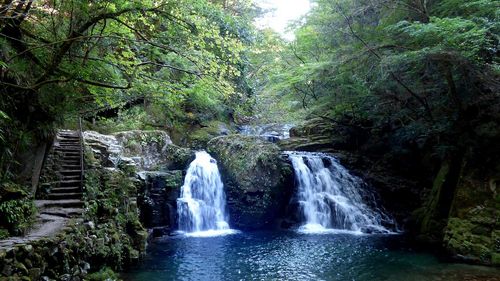
The charm of Osugidani lies in the waterfalls that appear one after another in a valley hemmed in by primeval forest and huge rocks. Led by Nanatsugama Falls (seven tiers, 120 m), chosen as one of Japan's Top 100 Waterfalls, they include Chihiro Falls (about 180 m), Nikoniko Falls (two tiers, 50 m), Hikari Falls (40 m), Kakure Falls (15 m), Yohachiro Falls (two tiers, 40 m) and Dokura Falls (18 m). Along the trail there are also scenic spots such as Shishibuchi and Heidoiwao, and the scenery woven from emerald-green water and enormous rocks is known as one of the finest gorge courses in Japan.
To visit, the only way is to walk the mountain trail that links the Miyagawa No. 3 Power Station and Odaigahara. The height difference is about 1,500 m; it takes about four and a half hours from the trailhead to Momonoki-yama-no-ie, and about six hours from there to Hinodegatake, the highest peak of Odaigahara. The route is meant for intermediate hikers, with rocky sections and chain sections scattered along the way, and beginners are urged not to enter on their own. There are very few places suitable for camping out, so staying overnight basically means reserving a mountain hut such as Momonoki-yama-no-ie or Awadani Hut.
On the trail, the section along the Miya River became impassable for six years after the flood damage of 2004. In 2010 it reopened except for part of the route, in August 2012 a forest-road course bypassing the Odai Forest Road was opened, and in April 2014 the collapsed spot near Hikari Falls was repaired and the whole route opened. After that, Typhoon No. 7 in August 2023 forced a temporary closure of the trail, which was lifted along the whole route on September 8, 2023. Conditions can change after heavy rain or typhoons, so check the trail status with the Odai Town Tourism Association or similar before setting out.
From around 1969, the prefectural enterprise bureau once studied a plan to build a multipurpose dam at Dainichigura. Objections over the impact on the national park followed one after another; on January 20, 1972, the governor announced that the plan was abandoned. The scenery you see today was protected in this way.
The climbing season usually begins with the mountain opening around April. The trail is managed by the Osugidani Climbing Center, a public interest incorporated association, and entry requires a cooperation fee, used for conserving the natural environment and rare plants and animals, maintaining the trail and securing the safety of climbers. The trail leads on to Odaigahara, and it suits those who want to take in mountain nature at length.
Sources
This article was written from the official, municipal and tourism-association sources above, and checked against them separately from the writing. Editorial policy
Last updated November 16, 2026