ABOUT
About this spot
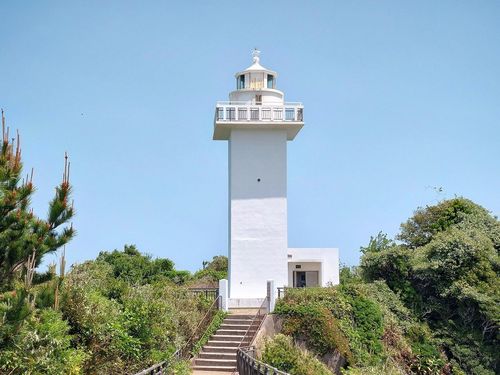
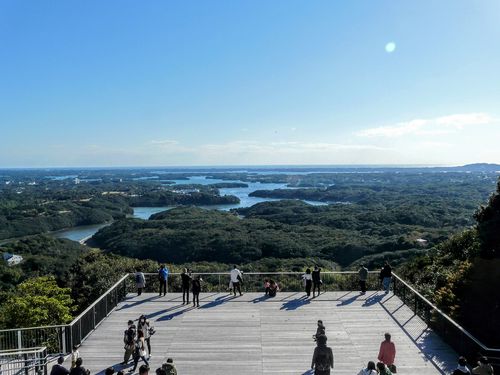
Daio-zaki Lighthouse is a white lighthouse in Nagiri, Daio, Shima City, Mie Prefecture. It stands on Cape Daio, which juts out from a sea-eroded terrace cliff at the southeastern tip of the Shima Peninsula, and is also called the "Nagiri lighthouse." It looks out over the Pacific, and the area lies within Ise-Shima National Park.
It was first lit on October 5, 1927 (Showa 2). The tower is white, tower-shaped and made of concrete, 22.50 meters tall, with the light at 45.53 meters above sea level. White and red lights flash alternately, one white and one red flash every 30 seconds. The light reaches 18.5 nautical miles (about 34 km) for white and 16 nautical miles (about 30 km) for red. It was chosen among the "50 Lighthouses of Japan" in 1998, and in 2013 the lighthouse and its gate posts and wall were registered as national Registered Tangible Cultural Properties.
Offshore of Cape Daio, the Enshu Sea and Kumano Sea meet. With many hidden and exposed reefs, it has long been known as a hazardous passage. A saury fishing boat disaster killed 51 people in 1913 (Taisho 2), and in 1918 (Taisho 7) the cruiser Otowa ran aground on Daio Rock; these events, among others, led to calls for a lighthouse. A radio beacon station was added in 1954, and the lighthouse became unmanned in 2004.
It is open to the public as a visitable lighthouse, and you can climb to the top. As of 2006 it was one of 14 such lighthouses in Japan. Opening conditions may change, so please check official information before visiting.
Nagiri has other sights too. On Shiroyama stand the ruins of Nagiri Castle, associated with the Kuki clan, and one theory makes it the birthplace of Kuki Yoshitaka. In 1832 (Tenpo 2) the "Nagiri Incident" took place, in which a shipwreck was faked to embezzle cargo, and it became the subject of Yoshimura Akira's novel "Shu no Maru Goyosen."
Painters have visited Nagiri since the Meiji era, and in 1996 the then Daio Town declared itself a "town of painters." In 1912 Orikuchi Shinobu visited and is said to have conceived his marebito theory there. The place has been the setting for many films, including Ozu Yasujiro's "Floating Weeds" (1959) and "Kimi no Na wa" (1953).
Sources
This article was written from the official, municipal and tourism-association sources above, and checked against them separately from the writing. Editorial policy
Last updated November 12, 2026