ABOUT
About this spot
Kinkaku-ji, formally Rokuon-ji, is a Rinzai Zen temple in Kita Ward, Kyoto. It is a sub-temple of Shokoku-ji and is known by the popular name Kinkaku-ji after its relic hall, the Kinkaku, or Golden Pavilion. In 1994 it was inscribed as part of the UNESCO World Heritage site Historic Monuments of Ancient Kyoto.
In the Kamakura period the court noble Saionji Kintsune built a villa here, later called Kitayama-dai. When the Saionji family declined, the villa fell into ruin, and only the pond is said to remain from that era. Ashikaga Yoshimitsu, the third shogun of the Muromachi shogunate, acquired the site and from 1397 began building the Kitayama-dono retreat. It was meant to express the Pure Land of paradise in this world, and in 1408 he welcomed Emperor Go-Komatsu there. After Yoshimitsu's death, the villa became a temple according to his will, with Muso Kokushi as founding priest, and it was named Rokuon-ji after Yoshimitsu's Buddhist title, Rokuon-in-dono.
The Kinkaku is a three-story building. The first floor enshrines a Shaka triad, the second is the Kannon Hall, and the third houses Buddhist relics. Each floor has a different architectural style: the first is shinden style, the second warrior-house style, and the third a Chinese-style Zen Buddhist hall. Pure gold leaf is laid over lacquer on the second and third floors, and the roof is made of layered thin wooden shingles and topped with a phoenix. During the Onin War, when many temples burned, the Kinkaku, the Ishi-Fudo-do and the Goma-do escaped the fires. In July 1950, however, a young monk set the Kinkaku on fire and it burned down. It was rebuilt between 1952 and 1955 based on the surviving drawings and records.
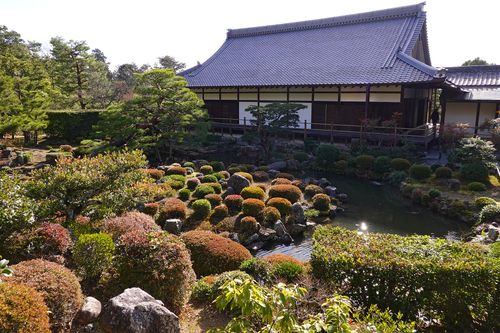
The Rokuon-ji Garden is designated a Special Historic Site and Special Place of Scenic Beauty. The central Kyoko-chi pond covers about 6,600 square meters and is set with islands such as Ashihara-jima and famous stones such as the Hatakeyama stone. The Ryumon Waterfall, which is 2.3 meters high, has a carp stone placed in reference to the Chinese tale of the carp that becomes a dragon, and Anmin-taku is said to be a pond that never dried up even in drought and was used for rain-praying rituals. A small island in the pond holds the Hakuja-zuka, a five-ring stone pagoda also said to be a guardian shrine of the Saionji family.
Within the grounds is the tea house Sekka-tei. It is a three-mat sukiya-style tea room that Horin Shosho had Kanamori Sowa build for Retired Emperor Go-Mizunoo in the Edo period, and it is named for the beauty of the Kinkaku in the setting sun. There is also the Fudo-do, whose principal image is a stone Fudo Myoo, revered as a hidden Buddha.
Sources
This article was written from the official, municipal and tourism-association sources above, and checked against them separately from the writing. Editorial policy
Last updated November 12, 2026