ABOUT
About this spot
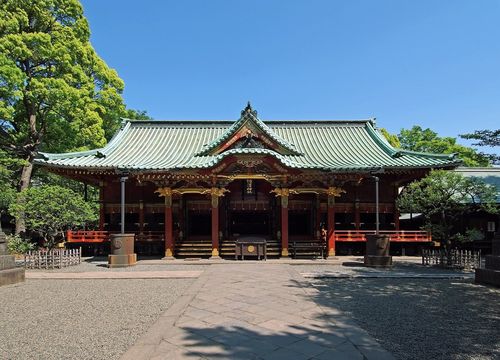
Hakusan Shrine stands in Hakusan 5-chome, Bunkyo Ward, Tokyo, in a residential area within walking distance of Hakusan Station on the Toei Mita Line. The shrine is said to be the origin of the district name "Hakusan." Formerly called Hakusan Gongen Shrine, it enshrines Kukurihime-no-mikoto, Izanagi-no-mikoto and Izanami-no-mikoto. It was a former district-level shrine and is counted among the "Tokyo Jissha," ten shrines with the status of semi-imperial-festival shrines. The ten are Nezu Shrine, Shiba Daijingu, Kanda Myojin, Hie Shrine, Kameido Tenjinsha, Hakusan Shrine, Shinagawa Shrine, Tomioka Hachimangu, Oji Shrine and Hikawa Shrine.
Its founding is traditionally dated to the 2nd year of Tenryaku (948), when a deity was invited from Hakusan Hime Shrine in Kaga Province and enshrined at what is now Hongo 1-chome. During the Genna era (1615-1624), on the order of the second shogun Tokugawa Hidetada, it was moved to Sugamo-hara, the site of today's Koishikawa Botanical Garden. In 1655 (Meireki 1), a residence for Tokugawa Tsunayoshi, then lord of the Tatebayashi domain, was to be built there, so the shrine moved to its present site. It received deep reverence from Tsunayoshi and his mother Keishoin, and is said to have drawn the faith of the Tokugawa shoguns' household afterwards.
Besides the main hall in the nagare-zukuri style, the precincts hold three auxiliary shrines: Kanto Matsuo Shrine, Inari Shrine and Sengen Shrine. Kanto Matsuo Shrine is dedicated to a deity of sake. Just to the left after passing through the large stone torii gate stands a monument commemorating a stone on which the Chinese revolutionary Sun Yat-sen is said to have sat. There is also a man-made Fuji-zuka, a mound modeled on Mount Fuji, known as Hakusan Fuji.
The main highlight is the hydrangea season of the Bunkyo Hydrangea Festival, held in June. About 3,000 hydrangea plants bloom across the shrine grounds and the adjoining Hakusan Park, and the festival is counted among Bunkyo Ward's "five great flower festivals." During the festival the Fuji-zuka is open to visitors, and various events are reported to be held, mainly on weekends. The mound can be climbed only while the hydrangeas are in bloom. The shrine's regular annual festival (reisai) is held on September 21.
The nearest station is Hakusan on the Toei Mita Line, and the shrine is also within walking distance of Hon-Komagome Station on the Tokyo Metro Namboku Line. Combine your visit with the Koishikawa Botanical Garden, which has a historical link to the shrine, for a walk around Bunkyo Ward.
Sources
This article was written from the official, municipal and tourism-association sources above, and checked against them separately from the writing. Editorial policy
Last updated October 29, 2026