ABOUT
About this spot
In 1792 (Kansei 4), Mt. Mayuyama collapsed in the wake of the eruption of Mt. Unzen-Fugen, and the castle town of Shimabara suffered great damage. During this disaster, known as the "Shimabara Taihen Higo Meiwaku," an area that had been a temple cemetery sank, and a large amount of groundwater welled up there to form Lake Shirachi. It is the only lake in Nagasaki Prefecture that was not made by people, and it is said to be the smallest sinkhole lake in Japan.
The lake is said to have been nearly 1 km long north to south just after it formed. Its appearance cut the Shimabara highway, and people crossed on rafts. In the following spring the Otonashi River was dug to drain it, and the lake shrank to about a quarter of its former size. Today it measures about 200 meters north to south and 70 meters east to west. The Otonashi River follows the old coastline, and its name is said to come from the fact that it has almost no slope, so the water flows without a sound.
From the lakebed, an estimated 40,000 tons of groundwater a day still wells up. This spring water is considered a typical "tectonic-type spring" produced by crustal movement during the collapse of Mt. Mayuyama, and the lake is a geosite of the Shimabara Peninsula Geopark. Tsukumo-jima in Shimabara is also said to have formed at almost the same time, so the lake preserves the memory of a disaster that reshaped the land.
Houses surround the lake, and life and water are close together. There is a communal washing place on the shore, and the spring water has been used as part of residents' daily water supply. On the lakeshore is Yamasaki Honten Brewery, a brewery that was started in 1884 (Meiji 17) by a family that moved from Kyoto with Matsudaira Tadafusa; it makes sake using the spring water. The Catholic Shimabara Church stands on the east shore, and Shirachiko Ryokudō Park has been laid out on the west shore.
The sights are the view of the clear spring water and the everyday scenes along the shore. On the other hand, eutrophication caused by household wastewater from the surroundings means that aquatic plants such as Canadian waterweed can grow in large numbers. Removal work is carried out from time to time, and the look of the water changes with the season.
By train, it is about 14 minutes on foot from Shitetsu Honsha-mae Station on the Shimabara Railway, or about 15 minutes from Minami-Shimabara Station. By car it is about 42 km from Isahaya IC on the Nagasaki Expressway, but the lake has no parking lot of its own, so use parking nearby. The shoreline is short, so a stroll around it takes little time.
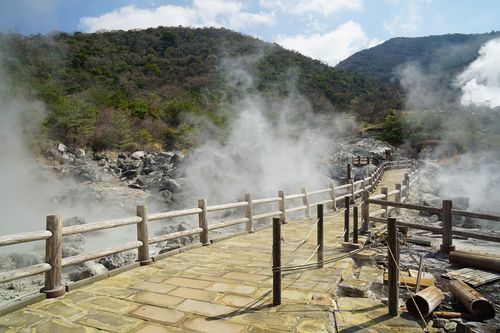
Shimabara Castle (about 1 km) is nearby, so the lake is easy to combine with a stroll through the castle town. Shimabara is known as a city of springs, and there are spring spots in town such as the "Koi no Oyogu Machi" spring. If you go farther, about 10.9 km away are the Unzen Hells and Unzen Onsen, where you can follow both the history of eruptions and the blessings of spring water in a single day.
Sources
This article was written from the official, municipal and tourism-association sources above, and checked against them separately from the writing. Editorial policy
Last updated November 16, 2026