ABOUT
About this spot
Okinawa Churaumi Aquarium is inside the National Okinawa Memorial Park (Ocean Expo area) near Cape Bise on the Motobu Peninsula in northern Okinawa Island. Its predecessor was the “Marine Life Park” exhibited at the 1975 (Showa 50) Okinawa International Ocean Exposition. It opened in August 1979 (Showa 54) as the National Okinawa Ocean Expo Memorial Park Aquarium, and its “Kuroshio Sea” tank, holding 1,100 tons of water, was regarded as the largest in the world at the time.
The present form dates from 2002 (Heisei 14). The old building closed on 31 August of that year, and the new building opened on 1 November and took its current name. In the final year of the old building there were just over 430,000 visitors, but in the first year after the new building opened the figure is recorded as having risen to 2.75 million. Management and operation are handled by the Okinawa Churashima Foundation.
The building is organized from the fourth floor down to the first. According to the official site, the fourth floor is “Invitation to the Open Sea,” the third is “Journey to the Coral Reef,” the second is “Journey to the Kuroshio” and the first is “Journey to the Deep Sea.” On the second floor, “Journey to the Kuroshio,” stands the central giant tank, “Kuroshio Sea.” The site also introduces the “Deep Sea” tank, which recreates Okinawa’s deep sea.
The water volume of “Kuroshio Sea” is 7,500 cubic meters, and it measures 35 meters long, 27 meters wide and 10 meters deep. The acrylic panel between the tank and visitors is 8.2 meters high, 22.5 meters wide and 60 centimeters thick, with a total weight of 135 tons, and it held a Guinness-recognized record until it was surpassed by an aquarium in Dubai in 2008. A whale shark 8.6 meters long was kept here. Because a mature whale shark reaches 9 meters, the depth was set at 10 meters so that its tail would not scrape the bottom. The aquarium was the first in the world to exhibit live Onitomakiei and Himeitomakiei (types of manta ray), and it has also succeeded in breeding the Nanyo manta (Nanyo-manta) in captivity.
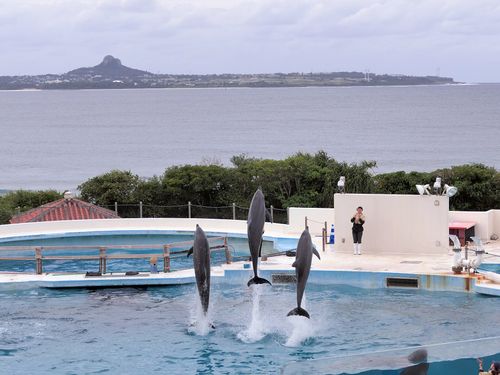
Sharks also receive great attention: the “Shark Research Room” introduces knowledge about sharks, and the neighboring “Dangerous Sharks” tank holds bull sharks and tiger sharks. As of the end of March 2016, about 740 species and 21,000 animals were kept. Outside the building are the Okichan Theater and the Dolphin Lagoon, where you can see bottlenose dolphins and others. The bottlenose dolphin “Fuji,” who was fitted with an artificial tail fin in 2005, was made into a film in 2007. The aquarium has also contributed to the discovery of new species, such as the Shimatsuno-koshiori-ebi (a squat lobster), Shinkai-sangogani (a coral crab) and Churaumi-kawarigin-chaku (a sea anemone).
Sources
This article was written from the official, municipal and tourism-association sources above, and checked against them separately from the writing. Editorial policy
Last updated November 12, 2026