ABOUT
About this spot
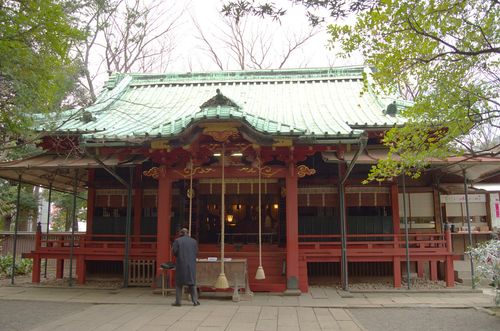
Hie Shrine in Nagatacho, Chiyoda Ward, Tokyo, is affectionately known as 'Sanno-sama,' and its main deity is Oyamakui-no-kami. Its origin is traced to the Kamakura period, when the Edo clan enshrined a Sanno shrine, and in 1478 Ota Dokan is said to have brought the Sanno shrine of Kawagoe into Edo Castle. After Tokugawa Ieyasu entered Edo Castle in 1590, the shrine was revered as the guardian of the castle and the tutelary deity of the Tokugawa family, and the people of Edo also worshipped it as 'the tutelary deity of Edo.'
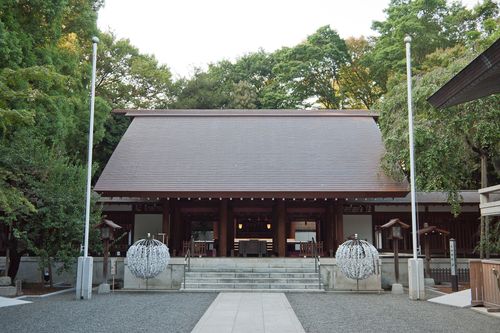
As Edo Castle was expanded, the shrine was moved outside the castle. After it burned in the great fire of 1657, it was moved to its present site in 1659. After Edo Castle became the Imperial Palace, the shrine was revered as the 'guardian of the Imperial Castle'; it was ranked as a Kanpei Chusha in 1882 and raised to Kanpei Taisha on the enthronement of Emperor Taisho. The shrine buildings erected in 1659 were once designated a national treasure, but in the war damage of May 1945 all of them except the Sanno Inari Shrine were destroyed, and the main hall's re-enshrinement ceremony was held in 1958. The treasure hall, built in 1979, holds 31 swords, including national treasures and important cultural properties, as well as items associated with the Tokugawa shoguns; among them, the tachi sword signed Norimune is a national treasure.
Many visitors pass through Sanno Otokozaka, the main approach, a slope of 53 stone steps rising from the front torii gate. The Sanno plateau where the shrine stands is also called Hoshigaoka and was once a scenic spot overlooking Tameike pond.
The Sanno Festival in June is counted with the Kanda and Fukagawa festivals as one of the three great festivals of Edo. In the Edo period it was an official festival of the shogunate and was called the 'Tenka Matsuri' (festival under heaven). By custom it alternates its main festival year by year with the Kanda Festival, and the Shinkosai, in which a procession with the Gohoren palanquin and portable shrines winds through central Tokyo, is held only in main-festival years, once every two years. Other annual rites include New Year's visits, the Setsubun festival and the Chushu Kangen-sai moon-viewing music festival.
From Exit 7 of the nearest station, Tameike-Sanno, Sanno Otokozaka is about a 3-minute walk, and from Exit 5 of Kokkai-gijidomae Station about 5 minutes. Because Akasaka feels so close, the shrine is often called 'the Hie Shrine of Akasaka' even though its address is Nagatacho, and it is easy to combine with a stroll through Nagatacho and Akasaka.
Sources
This article was written from the official, municipal and tourism-association sources above, and checked against them separately from the writing. Editorial policy
Last updated November 12, 2026