ABOUT
About this spot
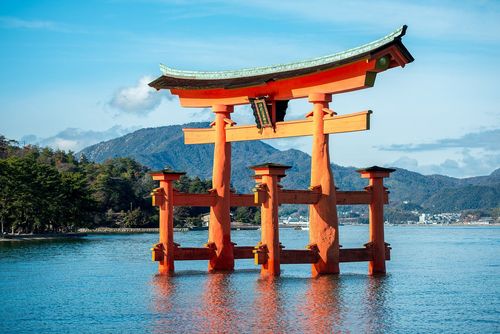
Mt. Misen rises 535 meters in the center of Miyajima (Itsukushima) in Hatsukaichi, Hiroshima Prefecture, and has long been an object of worship. One theory says the name comes from the mountain's resemblance to Mount Sumeru in Buddhist cosmology; another holds that "Oyama" (honorable mountain) changed into "Misen." The whole island and its surrounding waters lie within Setonaikai National Park, and the foothills form part of the registered area of the World Heritage site Itsukushima Shrine.
According to tradition, the monk Kukai (Kobo Daishi) founded the mountain in 806 as a training ground for Shingon esoteric Buddhism. Around a group of rock masses on the slope, archaeologists have found earthenware of the late Kofun to Nara periods and an agate magatama bead, suggesting that mountain worship centered on huge boulders had begun by the end of the Kofun period. Misen Hondo, the main hall on the mountain, is said to have been founded by Kobo Daishi, and its principal image is Kokuzo Bosatsu. Behind it stands the Gumonjido hall, where Kobo Daishi is said to have performed a hundred-day ritual; together with a sacred peak in Awa and Cape Muroto in Tosa, it is counted as one of the three great Shingon training sites in Japan. Near the hall, legends survive of the Mandala Rock, a large boulder carved with Sanskrit and Chinese characters said to have been written by Kobo Daishi, and of the Shakujo Plum, said to have grown from his planted staff. The bell known as Munemori's Bell, an Important Cultural Property, carries an inscription saying that Taira no Munemori donated it in 1177, and it is now kept in the main hall.
The summit area is a landscape of granite boulders, and the strange rocks created by weathering are said to be the basis of the mountain worship. Just before the top is Kuguri-iwa, a rock tunnel; other sights include Maku-iwa (Curtain Rock), a single slab of rock exposed on the mountainside, and Sai-no-Kawara, where many Jizo statues are enshrined beneath huge rocks. Miyama Shrine near the summit enshrines the same three goddesses as Itsukushima Shrine. From the roof of the observation rest house, rebuilt in 2013, a 360-degree view opens out, and on a clear day it is said you can see the mountains of Shikoku.
The primeval forest on the north slope is a national natural monument, known for an unusual mix of conifers such as fir and southern plants such as mimizubai. Hiking routes include the Momijidani, Daisho-in and Omoto courses; if you use the ropeway, you board at Momijidani Station and get off at Shishiiwa Station to head for the summit. Conditions at halls and trails on the mountain can change, so please check official information such as the Miyajima Tourist Association before you visit.
Sources
This article was written from the official, municipal and tourism-association sources above, and checked against them separately from the writing. Editorial policy
Last updated November 12, 2026