ABOUT
About this spot
The Sakitsu hamlet is a fishing village facing Yokaku Bay in Kawaura, Amakusa City, Kumamoto Prefecture. In 2018 it was inscribed as a World Cultural Heritage site as one of the component sites of the "Hidden Christian Sites in the Nagasaki Region and Amakusa," and it is the only component site in Kumamoto Prefecture. It has also been selected as a national Important Cultural Landscape. The character used for "saki" is officially written with a variant form meaning a standing cape.
Looking back at the history, in the Sengoku period Amakusa accepted Christian missionary work against the background of trade with the Portuguese and Spanish, and Sakitsu was known from early on as a good harbor. After the ban on Christianity in 1613, Christians began to live concealing their faith. In 1637, when the Shimabara-Amakusa Rebellion broke out, Sakitsu is said to have taken no part because it was cut off from the outside world. In the Edo period it was designated one of the officially recognized fishing villages that were granted fishing rights, and fishing flourished. The ban was lifted in 1873, and afterwards many people came to express their faith openly.
Sakitsu Church, at the heart of the hamlet, is the present church built in 1934. It stands on the site of the village headman's office, where fumi-e, the trampling of sacred images, was carried out during the ban, and it was built by Tetsukawa Yosuke of Nagasaki. It is a Gothic-style church whose interior has tatami mats, which is unusual for a church. Beside the torii of Sakitsu Suwa Shrine stood the wooden former Sakitsu Church, the first built after Christianity became public, constructed in 1888; its site is now included in the component site. The way the shrine and church stand close together tells the story of the hamlet's religious history.
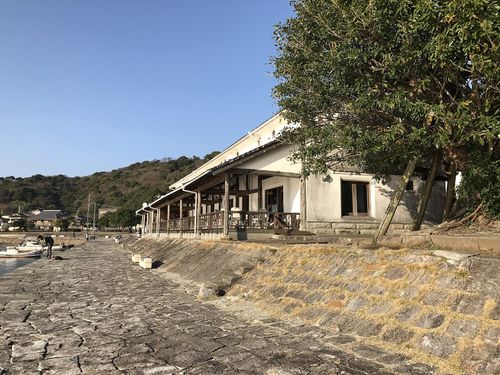
The fishing-village scenery is also part of Sakitsu's appeal. Small houses crowd along the sea, and on the mountain side they are built by cutting into the foot of the slope. The wooden platforms that jut out over the water are called "kake" and have been used for mooring boats, maintaining fishing gear and drying fish. The narrow alleys that run between houses are called "toya." It is explained that excavations and old maps confirm that land was extended by reclamation in the Edo period. Walking through the harbor and alleys, you see how fishing life and prayer overlap in the same space.
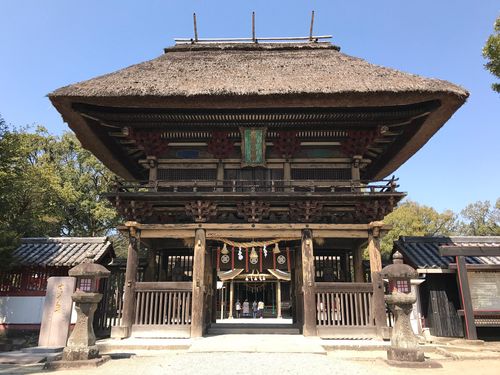
Sakitsu Suwa Shrine is where, during the ban, hidden Christians are said to have visited as parishioners while quietly reciting their prayers. The townscape, including its houses, is part of the site's value as the place where faith was handed down and sacred objects were kept during the years without missionaries. In the mountains behind Sakitsu lies the Imatomi settlement, which together with Sakitsu has been selected as a national Important Cultural Landscape under the name "Cultural Landscape of Sakitsu and Imatomi in Amakusa City."
It suits a plan to combine a visit to the church with a stroll through the alleys at a leisurely pace. Admission to the church may require a reservation, and the rules for viewing the interior and taking photographs may change over time. Please check the latest guidance from Amakusa City, the church and the tourist information office before you visit.
Sources
This article was written from the official, municipal and tourism-association sources above, and checked against them separately from the writing. Editorial policy
Last updated November 12, 2026