ABOUT
About this spot
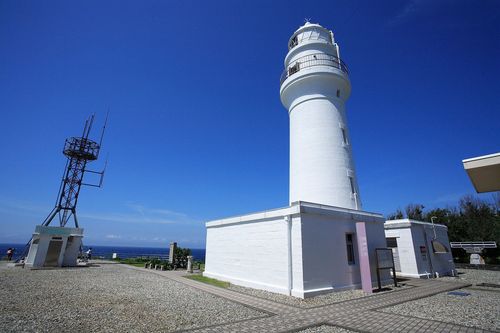
Kashinozaki Lighthouse stands on Kashinozaki, the eastern tip of Kii-Oshima island in Kushimoto, Wakayama Prefecture. It is one of the eight "treaty lighthouses" whose construction was promised in the Tariff Convention (the Edo Convention) of 1866, and it is known as Japan's first stone lighthouse, built to the detailed design of the British engineer Richard Henry Brunton. The tower from the early Meiji era is still in use as a lighthouse today. Visitors cannot go inside the tower, but it is said that an outside staircase lets them climb up for a view of the Nanki coast.
The site is valuable for more than the tower itself. The nationally designated historic site "Kashinozaki Lighthouse and Ruins of the Ertugrul Shipwreck" consists of four parts: the lighthouse; Funagoura, the rocks the Ertugrul struck; the landing place where survivors are said to have swum ashore; and the cemetery where the victims were buried. The Agency for Cultural Affairs describes the site as conveying the history of a large-scale international maritime disaster in modern times, the rise in disaster-prevention awareness that followed, and the exchange and commemoration between Japan and Turkey. The good state of preservation of the lighthouse, one of the earliest of the modern era, is also cited as a reason for its value.
The Ertugrul was a warship of the Ottoman navy. In September 1890 (Meiji 23) it ran aground in a typhoon off Kashinozaki and sank. Although there were heavy casualties, about ten of the survivors are said to have climbed the cliff and taken refuge at the lighthouse. The incident is tied to the history of exchange between Japan and Turkey; a memorial monument stands within walking distance, and the Turkish Memorial Museum is near the lighthouse.
Around the lighthouse grow clusters of narcissus said to have been planted in the early Meiji era by the British lighthouse engineers. The grounds also keep the old stone staff residence. A hipped-roof building with tall, symmetrically placed windows, it is a nationally registered tangible cultural property (building), and together with the residence at Mikomotojima Lighthouse it is regarded as one of the earliest keepers' houses of Brunton lighthouses in Japan. Walking this headland to see the lighthouse, the residence and the places tied to the shipwreck, you can follow both the work of the people who safeguarded the sea in the early Meiji era and the memory of a rescue that crossed national borders.
From JR Kushimoto Station, take the Kushimoto town community bus to the Kashino-todai-guchi stop and walk from there. The area is well suited to a visit together with the Turkish Memorial Museum and the Ertugrul memorial monument. What can be visited and the conditions around the site may change, so please check the latest information with the Kushimoto tourist association before you go.
Sources
This article was written from the official, municipal and tourism-association sources above, and checked against them separately from the writing. Editorial policy
Last updated November 12, 2026