ABOUT
About this spot
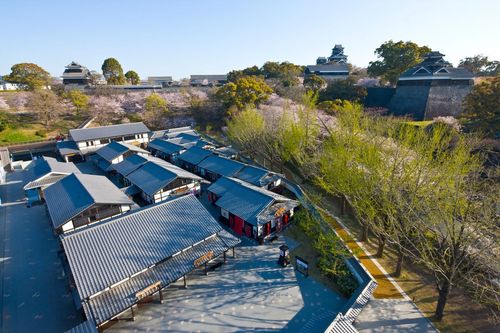
Kumamoto Castle stands in Chuo Ward, Kumamoto City, Kumamoto Prefecture, and is also known as Ginkgo Castle. It is a hill-and-flat-land castle of the tei-kaku-shiki type built on Chausuyama hill, and the castle site was designated a Special Historic Site in 1955. Of the surviving structures, 13 (11 turrets, one gate, and one wall) are Important Cultural Properties.
The site was formerly home to Chiba Castle, said to have been built by Ideta Hidenobu during the Bunmei era (1469-1487), and Kumamoto Castle (then written with different characters), built by Kanokogi Chikakazu in the Daiei and Kyoroku eras (1521-1531). In 1588 Kato Kiyomasa became lord of the northern half of Higo Province, and in 1591 he began building on the whole Chausuyama hill. In 1607 the way the place name Kumamoto was written changed: the character meaning "corner" was replaced with the one meaning "bear." After the Kato family was dispossessed, Hosokawa Tadatoshi entered the castle in 1632, and from then until the end of the Edo period it was the Hosokawa family's seat.
The stone walls are one of the castle's great attractions. They make extensive use of the shape known as musha-gaeshi, a specialty of Kiyomasa, and have long preserved their Edo-period appearance. The Uto Turret has three roofs, five stories, and a basement, and stands about 19 meters high. Excluding the main and secondary keeps, it is the largest turret in the castle.
During the Satsuma Rebellion of 1877, the main and secondary keeps and the Honmaru Palace were lost to fire. The current keeps are exterior reconstructions in steel-reinforced concrete completed in 1960.
In the Kumamoto earthquakes of April 2016, the castle was heavily damaged by the foreshock on 14 April and the main shock on 16 April. The Higashi Juhachiken Yagura and Kita Juhachiken Yagura turrets collapsed, and the Uto Turret and the Nagabei long wall were partly collapsed. Of about 79,000 square meters of stone walls, roughly 23,600 square meters, or 517 faces, suffered collapse, bulging, or loosening. Restoration has proceeded in stages: the Nagabei wall was restored in January 2021 as the first Important Cultural Property to be recovered, and work on the keep was completed in March 2021.
According to the restoration page on the castle management office's official site (as of December 2025), restoration of the Uto Turret is under way, and work continues on several stone walls, including the Hira Yagura turret and the north side of the stone gate. The temporary "Special Viewing Route" set up from 2019 to 2020 is scheduled to be removed once restoration is complete. It is a castle where you can see the restoration process itself.
The areas and routes you can visit change as work progresses. Before you visit, please check the restoration status and visitor information on the official website.
Sources
This article was written from the official, municipal and tourism-association sources above, and checked against them separately from the writing. Editorial policy
Last updated November 12, 2026