ABOUT
About this spot
Meigetsu-in is a temple of the Kenchoji branch of the Rinzai school in Yamanouchi, Kita-Kamakura. Its formal name is Fukugenzan Meigetsu-in, and its principal image is Sho Kannon. In the rainy season blue hydrangeas fill the grounds, which is why it is affectionately known as the "Hydrangea Temple."
According to temple tradition, it began in 1160 (Eiryaku 1), when Yamanouchi Sudo Tsunetoshi built the Meigetsu hermitage to pray for his father Toshimichi, who died in the Heiji Rebellion. The generally accepted account is that the actual founder was Uesugi Norikata, the Kanto Kanrei, who invited Mitsushitsu Shugon as founding priest. It was originally a sub-temple of Zenkoji, which is said to have been revived by Hojo Tokimune on the site of Saimyoji, built by Hojo Tokiyori. Zenkoji declined in the early Meiji era, and only the sub-temple Meigetsu-in remained. The grounds were designated a national historic site in 1984 and were certified as a component of a Japan Heritage story in 2016.
The famous hydrangeas number in the thousands along the approach and throughout the grounds. They are the old Japanese himeajisai variety, and nearly all of the flowers are blue; this clear blue is called "Meigetsu-in Blue." The story goes that after World War II there were not enough stakes for the approach path, so easy-care hydrangeas were planted instead. They are usually at their best in the second and third weeks of June.
The round window in the main hall (hojo) is called the "Window of Enlightenment." In Zen, the circle is said to represent enlightenment and Buddha nature. Beyond it the garden is framed like a picture, and the view changes with the seasons. In front of the main hall is a dry landscape garden, where weeping cherry trees serve as borrowed scenery at the end of March. The rear garden behind the main hall is normally closed; it is opened to the public twice a year, during the iris season in June and during the autumn foliage season.
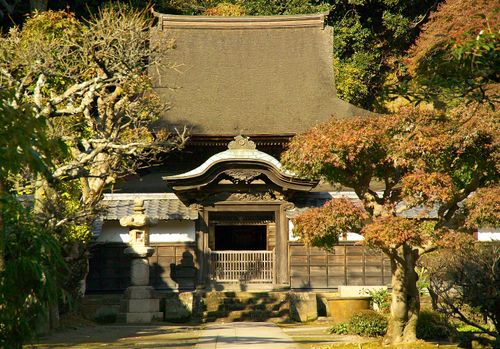
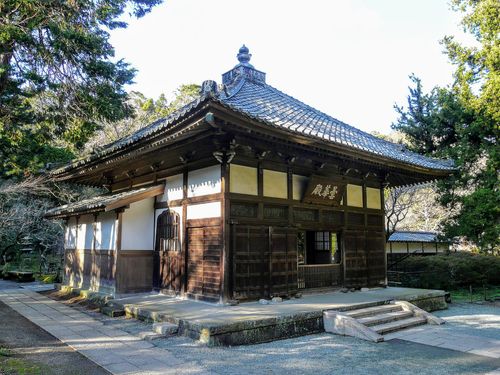
There is more to see in the grounds. The "Meigetsu-in Yagura" is one of the largest yagura (cave tombs) in Kamakura, with Buddhist images and carvings of the Sixteen Arhats on its walls, and it is also called the "Rakan-do." The thatched Kaisan-do (founder's hall), the well Tsurube no I, one of the Ten Wells of Kamakura, the traditional tomb of Hojo Tokiyori, and the bamboo grove are quiet highlights too. At the tea house Gesshoken you can rest while looking out over the garden.
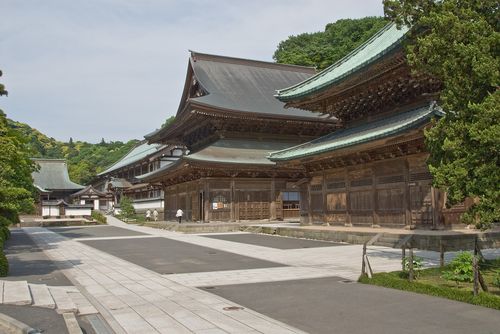
The hydrangea season in June and the autumn foliage season around December are extremely crowded. For a quieter visit, aim for a weekday morning in early June, the wintersweet season from late January to mid-February, the weeping cherry season at the end of March, or around September. Allow about an hour for a thorough visit. Kita-Kamakura is lined with old temples such as Engakuji, Jochiji, and Kenchoji, so combining them makes a full day of Kamakura Zen temples.
Sources
This article was written from the official, municipal and tourism-association sources above, and checked against them separately from the writing. Editorial policy
Last updated November 16, 2026