ABOUT
About this spot
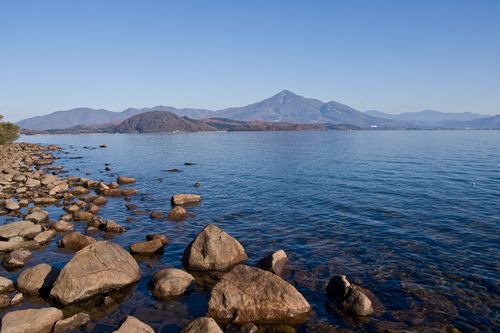
Nanko Park is a park in Shirakawa, Fukushima Prefecture, centered on Lake Nanko, which Matsudaira Sadanobu, lord of the Shirakawa domain, created. It is designated a National Historic Site and Place of Scenic Beauty and is said to be the oldest park in Japan. Walking paths and park grounds have been laid out around the lake, which has a circumference of about 2 km, and pines, cherry trees and maples create different scenery in each season.
Lake Nanko was built by Sadanobu in 1801 (Kyowa 1). It had more than one purpose: it is said to have served as an irrigation reservoir, a place for samurai to practice swimming and boat handling, and a place of recreation for the people. Local people took part in its construction, and it is said to have also been a form of relief for the poor. Sadanobu advocated the idea of "shimin kyoraku" (enjoyment shared by samurai and commoners) and is said to have opened the lake to commoners regardless of status. Because it was a place where ordinary people could relax even before the Grand Council of State proclamation of 1873 (Meiji 6), it is said to be called "the oldest park in Japan." In 1924 it was designated a National Historic Site and Place of Scenic Beauty. On March 25, 2010, it was selected by the Ministry of Agriculture, Forestry and Fisheries as one of Japan's "100 Selected Irrigation Ponds."
The lake measures about 700 m east to west and about 300 m north to south, and because it is shallow it is classed as a pond rather than an ordinary lake. It is thought to reproduce the charm of the Hu garden in Luoyang, China, and holds an important place in the history of Japanese gardens. Benten Island (Tennyo Island) in the lake is covered with red pines, and the tea house Kyorakutei stands on Kagamiyama on the shore. Stone monuments of the "Seventeen Views of Nanko" stand along the lakeshore, and the pine avenue known as the "Pine Grove of a Thousand Ages" is also a feature. The Nasu Mountains to the west and Mt. Seki to the southeast serve as borrowed scenery.
Kyorakutei, a tea house standing where it can overlook the lake, is a Cultural Property designated by the city. Its interior is normally closed to the public, but there are said to be public viewing days. West of Kyorakutei stands the Nanko Seventeen Views poem monument.
Facilities in and around the park are also worth seeing. Suirakuen is a well-composed stroll garden with a pond, where you can enjoy matcha and fresh Japanese sweets while looking at the garden. In the precincts of Nanko Shrine is the sacred tree "Rakuo-zakura," more than 200 years old. Meiji Memorial Hall is a building moved and restored from the former Nishishirakawa District Office built in 1883, and its first floor is used as a cafe.
A popular local specialty is Nanko dango, rice dumplings pounded with a mallet and served basically with sweet red bean paste or mitarashi sauce. In the lake you can see fish such as crucian carp and common carp and birds such as spot-billed ducks and mandarin ducks, and water plants such as water lilies and water shield grow there. It is also a well-known fishing spot.
To prevent avian influenza, feeding wild birds is prohibited. Boar traps are set in places around the paths, and visitors are asked not to stray from them. Please check the current situation with Shirakawa City's official information before you visit.
Sources
This article was written from the official, municipal and tourism-association sources above, and checked against them separately from the writing. Editorial policy
Last updated November 12, 2026