ABOUT
About this spot
Miyazaki Jingu stands on the northern side of Miyazaki City and is affectionately called Jinmu-sama by locals. Its chief deity is Emperor Jinmu, the first emperor (Kamuyamato Iwarebiko no Mikoto), enshrined together with his father Ugayafukiaezu no Mikoto and his mother Tamayorihime no Mikoto. The site is said to be where Jinmu kept a palace before setting out eastward. Its former shrine rank was Kanpei Taisha, and today it is a Beppyo Shrine of the Association of Shinto Shrines.
According to the shrine's own tradition, Takeiwatatsu no Mikoto, a grandson of Jinmu who is enshrined at Aso Shrine, began worshipping here in honor of his grandfather when he was appointed to govern Kyushu. Shrine buildings are said to have been raised in the reigns of Emperor Sujin and Emperor Keiko, and the hereditary governors of Hyuga repaired the shrine in the reign of Emperor Ojin. The shrine first appears in written records in the early Kamakura period, when the steward Tsuchimochi Nobutsuna built the halls and moved the shrine to its present site during the Kenkyu era. Later the Ito and Shimazu families and the lords of the Nobeoka domain, the Arima and Naito, repeatedly donated land and rebuilt or repaired the buildings. After the Meiji Restoration its rank rose as a shrine linked to Emperor Jinmu: it became a Kanpei Taisha in 1885 and took the name Miyazaki Jingu in 1913.
The present buildings were completed in 1907 with donations from all over Japan. They were designed by Ito Chuta, professor emeritus of the Tokyo Imperial University, and built with local Sano cedar. The straight, simple lines, with chigi and katsuogi on the roof, show a strong influence of the Shinmei style of Ise Jingu, and using cedar for a shrine's main timber is said to be unusual. In 2010 eleven structures, including the main hall, were registered as national Tangible Cultural Properties.
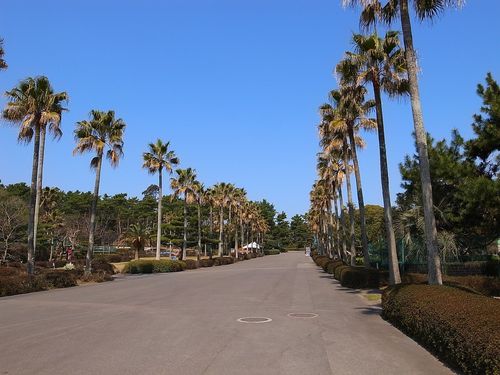
The first torii gate stands outside the grounds, and an approach of about 800 meters leads from it to the second torii, lined with Nagi trees. Inside are a sacred pond, the Chokokan (the former treasure hall) and a yabusame archery ground. The giant wisteria (Oshirafuji) of Miyazaki Shrine is a national Natural Monument, designated in 1951, and is said to be the largest of its kind in Japan; it was transplanted in 1907.
Every April the Jinmu Tenno festival includes sacred yabusame horseback archery, revived as part of the celebrations of the 2,600th anniversary of the imperial era. At the grand festival held on the weekend after the main annual rite, a portable shrine is followed by the decorated Shan-shan horse and a procession of children to the resting places. In 1940 the grounds were enlarged and the Chokokan rebuilt for that anniversary.
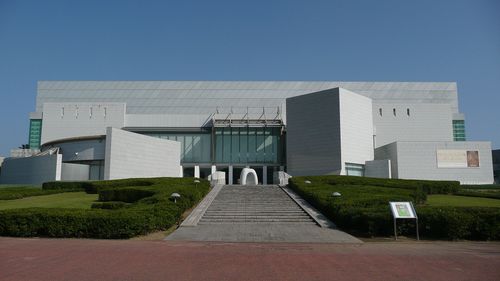
The Miyazaki Prefectural Museum of Nature and History lies on the north side of the grounds, and about two kilometers north of the shrine, on a hill, stands the Hakko no Motohashira (Tower of Peace), built by the prefecture in the same year, 1940. Check the shrine's official website before your visit for opening times and events.
Sources
This article was written from the official, municipal and tourism-association sources above, and checked against them separately from the writing. Editorial policy
Last updated November 12, 2026