ABOUT
About this spot
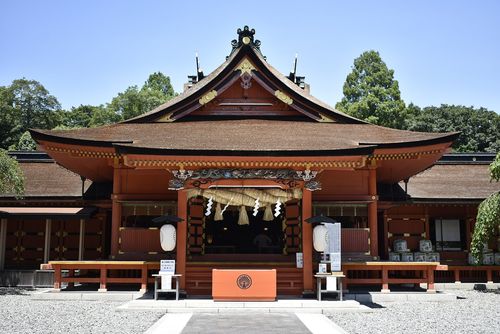
Kunozan Toshogu is a shrine standing on top of Mount Kuno (Kunozan) in Suruga Ward, Shizuoka. Its deity is Tosho Daigongen, that is, Tokugawa Ieyasu, and it is regarded as the origin of the Toshogu shrines across Japan. From the summit, 216 m above sea level, Suruga Bay spreads out below, with the Izu Peninsula visible to the east and Omaezaki far off to the west. Together with Nihondaira to the north, the mountain was formed by an ancient uplift of the seabed, and it is a National Historic Site.
Ieyasu died in 1616 (Genna 2) at the end of a life of 75 years. In his will he asked that his body be buried on Mount Kuno, that his funeral be held at Zojoji Temple in Edo, that his mortuary tablet be placed at Daijuji Temple in Mikawa, and that a small hall be built to enshrine him at Nikko-zan after the first anniversary of his death. His remains were buried on Mount Kuno as instructed, and the shrine buildings were constructed on the order of the second shogun, Hidetada. Work on the Nikko shrine (today's Nikko Toshogu) began at about the same time. It is said that in 1568 (Eiroku 11) Takeda Shingen moved Kunoji Temple, which stood on the mountain, and built Kuno Castle here. Ieyasu is said to have remarked, while living in Sunpu, that he thought of Kuno Castle as the main enclosure of Sunpu Castle.
The shrine buildings are in the gongen-zukuri style, finished entirely in lacquer and brilliant colors. They were built 19 years before Nikko Toshogu, and techniques of the Momoyama period were also used in the carvings, patterns and bracket sets. The main hall, the connecting hall (Ishi-no-ma) and the worship hall were designated National Treasures in December 2010 (Heisei 22) as representative architecture of the early Edo period. In addition, 13 structures including the Karamon gate, the East Gate, the Mausoleum Gate, the tamagaki fence, the roofed corridor, the two-story gate, the drum tower and the kagura hall are Important Cultural Properties. Near the summit behind the main hall stands the mausoleum pagoda (Byosho Hoto, also called the Shinbyo), built where Ieyasu is buried.
The approach is the omote-sando, which climbs the south slope facing Suruga Bay in a winding course along 1,159 stone steps. It is also possible to visit by taking the Nihondaira Ropeway from Nihondaira.
The affiliated Kunozan Toshogu Museum holds more than 2,000 cultural properties related to Ieyasu and the successive shoguns of the Edo shogunate. Items handed down at the shrine include a suit of armor (Shida Gusoku) said to have been used by Ieyasu, and a National Treasure sword signed Sanetsune. Some areas may be inaccessible because of repairs or events, so please check the official website before you visit.
Sources
This article was written from the official, municipal and tourism-association sources above, and checked against them separately from the writing. Editorial policy
Last updated November 12, 2026