ABOUT
About this spot
Sakura Castle stood in Jonai-cho, Sakura City, Chiba Prefecture, and in the Edo period it was the seat of the Sakura domain. The site is now maintained as Sakura Castle Ruins Park and is the only castle in Chiba chosen as one of Japan's 100 Famous Castles. It was a hirayama-type castle built on a plateau, with its enclosures lined up in a row, and it is also known as Kashima Castle.
Near the end of the Sengoku period a castle connected with the Chiba clan is said to have stood here, and there are several theories about how it came to be built. In 1610, in the Edo period, construction resumed under Doi Toshikatsu on the orders of Tokugawa Ieyasu, and the castle was completed. Later, senior retainers of the shogunate such as the Hotta family served as lords. Instead of a keep, the castle had a three-story, four-level turret called the Gosankai Yagura. The keep burned in 1813 in a fire, and after the castle was abolished in 1873 its buildings were sold off and removed.
A major feature of the castle is that it uses no stone walls. Its defenses are earthen ramparts and dug dry moats, and the layout of the main, second and third enclosures, the Shiinoki enclosure and the Tenjin enclosure is still well preserved. The huge umadashi outwork, the dry moats and the ramparts of the keep and copper turret sites are especially well kept, conveying the power of an earthen castle. Among the buildings that survive is a yakui-mon gate.
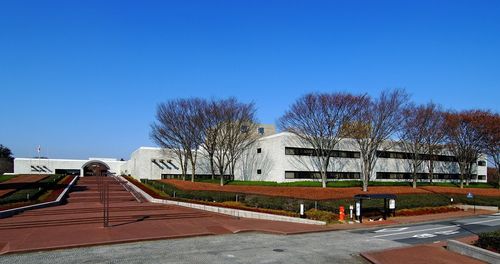
Near the keep site stands the "Meoto Mokkoku," a tree said to be about 400 years old and designated a natural monument of Chiba Prefecture. Within the castle grounds stands the National Museum of Japanese History, opened in 1981, with materials on Japanese archaeology, history and folk culture. The park management center at the east end displays castle models, old photographs and excavated objects,.
There are flowers through the seasons. Plum blossoms are at their best from late February to early March, cherry blossoms in late March, and iris in early to mid June. Because army regiments were stationed here from the Meiji era, remains such as an ammunition depot survive, so the place layers modern history on the castle.
The enjoyment is in walking slowly through this hilly earthen castle. Walking the heights of the moats and ramparts shows how a castle without stone walls was defended. It is about a 20-minute walk from Keisei Sakura Station and about 25 minutes from JR Sakura Station, so it fits easily into a historical walking route.
Sources
This article was written from the official, municipal and tourism-association sources above, and checked against them separately from the writing. Editorial policy
Last updated October 29, 2026