ABOUT
About this spot
Haruna Shrine is in Harunasan-machi, Takasaki, Gunma Prefecture, and honors the deity of Mt. Haruna, one of the three Jomo mountains along with Mt. Akagi and Mt. Myogi. It is an Engishiki-listed shrine, ranked sixth in the old Kozuke Province, and was formerly a prefectural shrine. The chief deities today are Homusubi no Kami, god of fire, and Haniyamahime no Kami, goddess of earth, and deities of water and mountains such as Oyamatsumi no Kami are enshrined with them. Its founding is traditionally placed at the end of the 6th century, and the Agency for Cultural Affairs describes it as a shrine on the southern slope of Mt. Haruna.
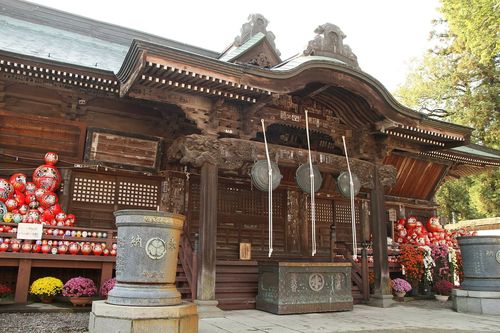
The heart of the precincts is a flat area where a strangely shaped rock called Misugata-iwa rises. Haruna Shrine regards this rock as its main sanctuary: the main shrine is built against it, and the sacred object is enshrined in a cave inside the rock. The main shrine, offering hall and worship hall, completed in 1806, form a Gongen-style complex noted for finely detailed carving and rich coloring. Around it stand the Kokuso-sha shrine and the Gakuden (votive plaque hall), the Kaguraden (sacred dance hall) and the Soryu-mon (Twin Dragon Gate), while the Shinkoden (hall for the deity's procession) and the Zuishinmon gate stand apart to the south. These six structures are designated Important Cultural Properties.
The Soryu-mon is a four-legged gate richly decorated with eave karahafu gables and carvings, and the Kaguraden has a karahafu gable roof. The Agency for Cultural Affairs regards these buildings, together with the main shrine buildings, as outstanding works representing northern Kanto in the late Edo period.
Haruna was long a place where Shinto and Buddhism were combined. From the medieval period it was called Mangyo Gongen, and in the early modern period it was treated as a temple named Harunasan Gandenji. A three-story pagoda, now the shrine's sacred treasure hall, still stands in the grounds and kept its form after the separation of Shinto and Buddhism. Remains of an ancient monks' lodging found in the precincts suggest it was opened as a training ground for mountain ascetics. In the Edo period, through the work of the oshi (guides) at each lodge, the Haruna-ko devotional associations spread across Kanto, Koshinetsu and Mutsu Province.
In the grounds stands the Yatate Sugi cedar, a national natural monument, and a legend says Takeda Shingen shot an arrow into it while praying for victory. Two formations of huge rocks, one of them the Kurakake-iwa, are a designated Scenic Place of Takasaki City. The area centered on the shrine forest is also a Gunma Prefecture green environment conservation area.
In recent years large-scale repair projects on the shrine buildings and gates have been carried out in stages. Because the areas you can view may change depending on the repairs, please check the official website before your visit.
Sources
This article was written from the official, municipal and tourism-association sources above, and checked against them separately from the writing. Editorial policy
Last updated November 12, 2026