ABOUT
About this spot
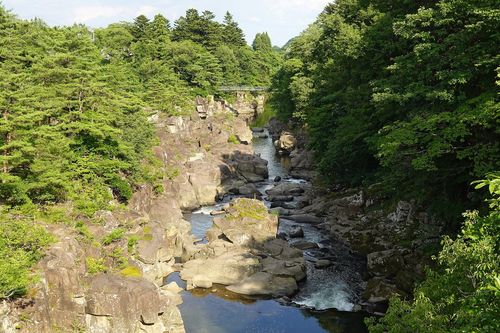
Geibikei is a gorge along the Satetsu River in Higashiyama, Ichinoseki City, Iwate Prefecture. The river rises on Mt. Takanosu in the northeast of Ichinoseki and has cut along the joints of a Paleozoic limestone layer found in the Nanbu Kitakami mountains. Cliffs from several tens of meters to about a hundred meters high line roughly two kilometers of the river, and the surrounding slopes are covered with broadleaf forest mixed with red pine. Geibikei is counted among the One Hundred Views of Japan and is designated a Place of Scenic Beauty by the national government.
The name comes from a knob-shaped stalactite jutting out on the south side of the upper gorge, which resembles the nose of a "gei," a lion. The cliff of Daigeibiiwa, towering at the far end of the boat ride, is the gorge's signature view. The place was once so hidden that even some local people did not know where it was. In 1834 Seki Yoken described it as "Higashiyama Daifu-iwa" in a regional gazetteer, and the traveling painter Minomushi Sanjin is said to have made it known across the country. The name "Geibikei" is said to have come into official use around the end of the Meiji era.
Sato Geigan devoted himself to opening up the gorge. Continuing the wishes of his father, Sato Todan, he invited his teacher Oka Rokumon and welcomed scholars and artists. When a plan arose to build a power plant at the mouth of the Satetsu River, he judged that legal protection was needed to preserve the scenery, asked Dr. Miyoshi Manabu to survey the gorge, and pushed a preservation campaign. Visitors are said to have included Miyazawa Kenji, Tayama Katai, Inoue Enryo, and Otsuki Fumihiko.
The boat ride is said to have begun when Geigan borrowed a boat that an inn in town used for floating timber and guided literati along the river. Today it is operated by Geibi Kanko Center. A boatman poles the boat with a single pole and is also known for singing "Geibi Oiwake." Named rocks line the banks: Kyomeiiwa, which looks like a big mirror stood upright; Fujiiwa, wrapped in wisteria vines; Ryounganiwa, which looks like a face; Amayoke-no-iwa, which overhangs the water and is said to have served as shelter from rain; the Meoto-iwa pair of Sofu-iwa on the left bank and Shofu-iwa on the right; Kinpekiiwa, covered in red and yellow leaves in autumn; Kyokuheiiwa, like a folding screen; Bakuriiwa, whose ridge pines look like a horse's mane; and Shishigahana. Looking up at them one by one from the boat is part of the pleasure.
The gorge changes with the seasons. In spring, fresh greenery is joined by wisteria, wild lilies, and the Geibi sekisho flower, and in autumn the walls glow as if painted with poured color. In winter, snow drifts down while you view an ink-wash landscape from a kotatsu boat.
The gorge also has a legend about Santaro, a devoted son of the late Edo to Meiji period, and Sayo, a young woman who loved him and is said to have thrown herself from Shishigahana. The black iron sand mixed into the river sand is said to have washed off Sayo's skin, and the fish living in the gorge are said to be her incarnation.
Nearby you can also visit the Higashiyama Washi papermaking house, Yugendo cave, and the Stone and Kenji Museum. Boat operation can depend on weather and river conditions, so please check the official website before you visit.
Sources
This article was written from the official, municipal and tourism-association sources above, and checked against them separately from the writing. Editorial policy
Last updated November 12, 2026