ABOUT
About this spot
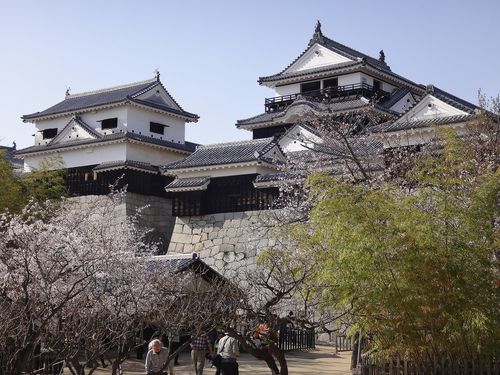
The Matsuyama Castle Ninomaru Historical Garden is a historic garden in Matsuyama, Ehime Prefecture, laid out on the site of the ninomaru (second enclosure) of Matsuyama Castle on Mount Shiroyama. The castle was built by its first lord, Kato Yoshiaki, and the ninomaru consisted of the front palace that served as the center of the domain's government, and the inner palace where the lord's family lived. The garden opened in 1992 and, based on excavations and old maps, expresses the floor plans of the former palace on top of the surviving remains.
The garden divides broadly into the site of the front palace and the site of the inner palace. The front palace site, in the northern half, is the Citrus and Flower Garden, where citrus fruits from various regions and flowers trace the layout of the old rooms. The inner palace site, in the southwest, is the Flowing Water Garden, where water, gravel and lawn mark out the rooms. In the Rinsentei garden on the east side, ponds and a waterfall are set against exposed rock to express wabi and sabi.
One highlight is the remains of the great well. Excavation drew attention to its sheer size, and it is displayed exposed just as it was found. Only the western half had been exposed; the eastern half was covered by a room with a hearth for building fires, and its foundation remains. The slightly lower area reached by climbing the stone steps is the site of an underfloor passage, and in case of fire water is thought to have been drawn up in wooden buckets and carried through an underground passage.
There are also reconstructed buildings. The Yotsuashi-gomon gate on the north side was the official gate and was rebuilt on the model of the Ninomon, the second gate of the main enclosure. The Tamon-yagura on the west side is a long turret running along the top of the stone wall. It has defensive features such as vertical arrow slits, square gun ports and stone-drop openings projecting from the wall. The name tamon-yagura is thought to come from the Tamon-yama Castle that Matsunaga Hisahide built in Yamato, where such a turret was first made. The exterior of the corner turret was reconstructed with reference to Meiji-era photographs and the turrets of the main enclosure. There are also a well house modeled on the one in the main enclosure and a rice storehouse modeled on the one at Nijo Castle. The storehouse was originally an accounting room, but in the latter part of the Matsudaira era it became a storehouse for salt and miso; it is regarded as one sign that the domain residence moved from the ninomaru to the sannomaru (third enclosure) and the ninomaru lost its political function.
The heart of the front palace was the shoin, the study hall used for official ceremonies. At the site of the great shoin there was a decorated alcove called a michodai, where the seat was one step higher than the visitor's and richly ornamented to show the difference in rank. It is said to have been rebuilt to stress the high standing of the Matsudaira family, a close relative of the shogun. Events held in the shoin included lectures on learning, noh and shimai dance, renga poetry gatherings and displays of armor. The lord's private room faced southeast, where the sun shines best, and its layout is now recreated as a citrus orchard.
In one corner of the garden is a suikinkutsu, a buried jar that you listen to as drops of water pass through it into a basin underground and echo. It is a landscaping technique said to have been devised by Kobori Enshu, a tea master, architect and garden designer of the early Edo period. Because the sound changes with the amount of water, the size and firing of the jar and the stones buried around it, no two are alike, and even a single suikinkutsu is said to sound different by time of day and season.
There are three buildings in the garden: Kankotei, Jurakutei and Katsuyamatei. Katsuyamatei was built above Rinsentei with reference to the Katsura Imperial Villa and others, and is named after Mount Shiroyama, which was once called Katsuyama. Jurakutei stands at the best spot for viewing Matsuyama Castle, and has a one-bay-wide veranda and a mizuya preparation room so that it is easy to use for tea gatherings and haiku meetings. These can be used as rental rooms.
What is open and available changes with the season, so please check the Matsuyama Castle website before you visit.
Sources
This article was written from the official, municipal and tourism-association sources above, and checked against them separately from the writing. Editorial policy
Last updated November 12, 2026