ABOUT
About this spot
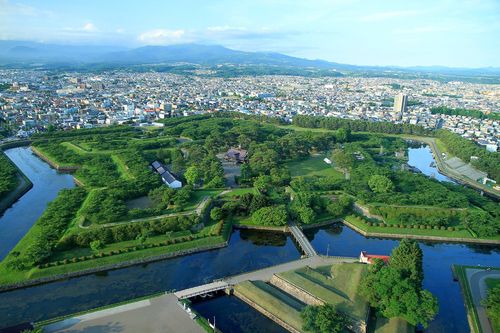
Mt. Hakodate (Hakodateyama) rises at the western edge of Hakodate city in Hokkaido. It is 333.8 meters high and about 9.5 kilometers around. It is both a volcano and a tied island (a former island joined to the mainland), and the center of Hakodate stretches across the sandbar that links the mountain to the land. Because it looks like a reclining ox, it is also called Gagyuzan, the "reclining ox mountain."
The mountain's foundation is said to be material erupted from a seabed volcano about 25 million years ago. Repeated uplift and subsidence, followed by erosion from currents, wind and rain, left an isolated island; sediment then built a sandbar, and the island is explained to have joined the mainland about 5,000 years ago. The name also covers a group of 13 peaks, including Goten-yama, where the observation deck stands, as well as Yakushi-yama, Tsutsuji-yama and Hachiman-yama.
The mountain's history cannot be told without its fortress. Construction began in 1898, and gun batteries, observation posts and other facilities were built across the whole mountain. Once it became a fortress zone, the mountain was treated as a military secret and ordinary people were kept out for a long time. It was opened to citizens in 1946, after the Second World War, and is now designated a Hokkaido Heritage site as "Mt. Hakodate and the Battery Ruins." Parts of the battery ruins can be visited, though some areas are closed because of the risk of collapse.
The main attraction is the view from the summit observation deck. The night view is sometimes called the "million-dollar night view" and is regarded as a leading highlight of Hakodate sightseeing. You can reach the summit by the Mt. Hakodate Ropeway, opened in 1958, or by one of several hiking trails; an easy route is said to take about an hour one way. In the evening hours, private cars and rental cars are restricted from driving to the summit, while taxis may pass. Crowding levels can be checked through a distribution system on the official website.
The mountain's nature is also worth noting. Its natural forest has been selected by the Environment Agency as a Rank A specified plant community. On Tsutsuji-yama, volunteers have planted Ezo yama-tsutsuji, Hakodate's city flower, over many years. The cedar forest was planted by the farmer Kurayama Unosuke during the Bunka era (1804-1817) and is described as the oldest man-made forest in Hokkaido. Picking trees or flowers on the mountain is prohibited by city ordinance.
The ropeway suspends service during periodic maintenance. The hiking trails are closed in winter, usually from around early November, so please check the official website for the latest conditions before you go.
Sources
This article was written from the official, municipal and tourism-association sources above, and checked against them separately from the writing. Editorial policy
Last updated November 12, 2026