ABOUT
About this spot
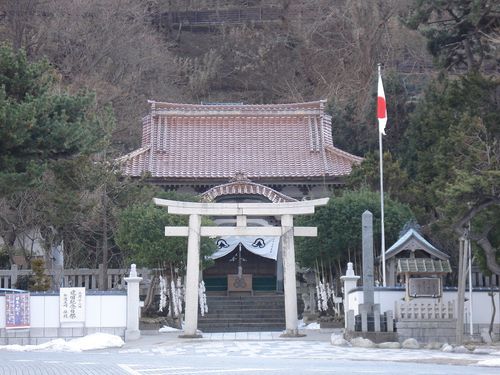
This shrine stands on a rise in Yachigashira, at the southeastern foot of Mt. Hakodate, facing east. From the grounds you can look down over the city of Hakodate, and locals fondly call it Hachiman-san. It was formerly ranked as a Kokuhei Chusha (a national shrine of the middle rank) and is now a Beppyo Jinja listed by the Association of Shinto Shrines. The main deity is Homuda-wake-no-mikoto (Emperor Ojin), and the Sumiyoshi deities and the Kotohira deity are enshrined alongside him.
According to tradition, the shrine was founded in 1445. When Kono Masamichi, the lord of Kameda District, built a castle in Motomachi in Hakodate, he is said to have invited the god Hachiman there as the castle's guardian. In 1512 the Kono clan was driven from the castle by an attack from the Ezo and fled to Akagawa village with the deity. In 1649 Ichime, a shrine maiden of the Kono family, received a divine message, and the shrine was returned to the site of the Kono mansion in Motomachi. In 1804, when the Hakodate magistrate's office was established, a hall was built in Kaisho-cho at the expense of the shogunate, and the shrine was revered as the head shrine of Ezo. The hall was lost in a fire that spread from nearby in 1878, and it was rebuilt at the present site with government funds and the deity was moved here in 1880.
The present buildings were rebuilt between 1912 and 1915. The main hall, the offering hall and the worship hall are joined in a style close to gongen-zukuri. The main hall is in the seitei-zukuri (hie-zukuri) style, similar to the main hall of Hiyoshi Taisha in Shiga, and all three halls have copper roofs. The worship hall has a curved karahafu gable over its front porch, and the whole arrangement is also called seitei hachimune-zukuri. The curved copper roofs set against the trees on the hill behind make the most memorable view in the grounds.
One of the highlights is the octagonal great portable shrine made in 1894. It is covered in gold leaf and has been designated a tangible cultural property (craft) of Hakodate City. The annual festival is held on August 15, with ceremonies over the three days around it. In the Mikoshi Togyo Festival, held every other year after the annual festival, the portable shrine is carried around the city, and when it returns, the bearers run up the 134 stone steps of the approach. The grounds also hold Tsuruwaka Inari Shrine, which enshrines Ukanomitama and was moved here.
It is about a 10-minute walk from Yachigashira tram stop, and 30 minutes to an hour is enough for a relaxed visit including a stroll around the grounds. The approach has 134 stone steps, the same ones the bearers run up during the Mikoshi Togyo Festival, so comfortable shoes are a good idea. The shrine stands at the foot of Mt. Hakodate, so it combines easily with a visit to the mountain.
Sources
This article was written from the official, municipal and tourism-association sources above, and checked against them separately from the writing. Editorial policy
Last updated November 5, 2026