ABOUT
About this spot
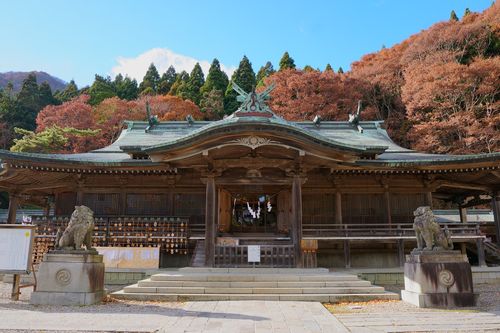
In the port town of Esashi in southwestern Hokkaido, facing the Sea of Japan, this shrine is said to be the oldest in the island. Its former rank was prefectural shrine, and it enshrines Amaterasu Omikami, Ame-no-Koyane and the Sumiyoshi deity. It is called the head shrine of Oshima Province, and the business cards handed out at its annual festival carry that description. The people of Esashi, which prospered on herring fishing, have long offered their thanks and prayers for good catches here.
According to the shrine's tradition, it was founded in 1216 in Tsubana-cho on the shore of Esashi (some tourist information gives 1447 as the founding year, so the date varies by source). The origin is told in a legend. An old woman called Orii-sama, who lived in a hut on the beach at Tsubana, saw light shining from Kamuishiri island and crossed to it, where an old man gave her a small sake jar. When she scattered the water from it in the sea, huge schools of herring came in and the village celebrated a great catch. When the villagers came to thank her, Orii had already vanished, and the story says the god image left in her hut was enshrined as Ubagami, the Old Woman Deity. There is also a theory based on a tale of an elderly Ainu couple, in which the old man was enshrined at the Ebisu hall on Kamome Island and the old woman at Ubagami Daijingu.
The shrine moved to its present site in 1644. It was deeply revered by the Matsumae clan, lords of the domain, and the ninth lord, Michihiro, donated a plaque reading Kofuku Koi. In 1799 Mogami Tokunai, who was surveying Ezo, misread the characters for Koi (孔夷) as Koi (紅夷, 'red barbarians', meaning Russians) and reported it, which put the domain in danger of being dissolved. It was later found to be a mistake caused by cursive writing, and the plaque was replaced by the present one reading Komin-den. In 1817 the imperial court granted the shrine the rank of Shoichii. The grounds contain the Orii shrine, and in Tsubana-cho the Well of Orii-san is still looked after by local people.
The highlight is the Ubagami Daijingu Togyosai festival, held each year from August 9 to 11. It began as thanks for big herring catches and is introduced as the oldest festival in Hokkaido. Thirteen floats follow the portable shrine procession, and the festival music carries the tradition of Kyoto's Gion Festival. On the final night, 13 floats decorated in gold and silver gather in Shinchi-cho. Outside festival days, you can look quietly at the shrine hall and the sea-breeze townscape.
To get there, get off the Hakodate Bus at Ubagami-cho Ferry-mae. By car it is about 10 minutes from Michi-no-Eki Esashi, and about 90 minutes from Hakodate IC on the Hakodate Shindo. About 30 minutes is a good guide for a visit and a stroll through the grounds. When you walk around Esashi, you can combine this with Kamome Island and feel the history of herring fishing and the port.
Sources
This article was written from the official, municipal and tourism-association sources above, and checked against them separately from the writing. Editorial policy
Last updated November 16, 2026