ABOUT
About this spot
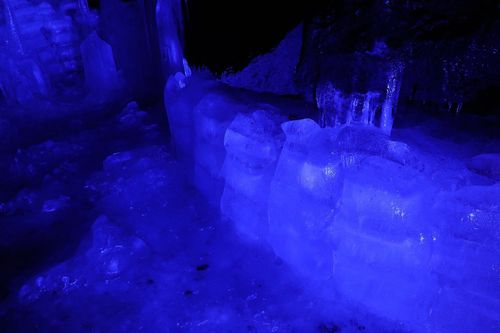
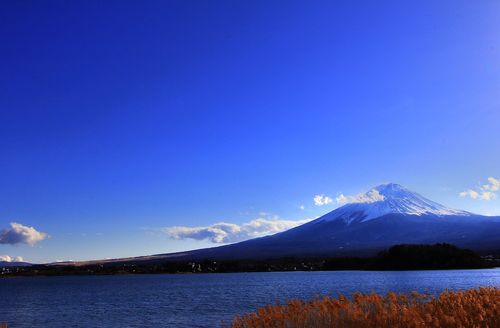
Narusawa Ice Cave is a lava cave in the Aokigahara forest in Narusawa Village, Yamanashi Prefecture, and is designated a national natural monument. It opens beneath the forest spread over the northwest foot of Mount Fuji, and it is known for the icicles that can be seen in its cold interior all year round.
The cave originates from a large eruption on the northwest slope of Mount Fuji in the sixth year of Jogan (864), early in the Heian period, known as the Jogan eruption. The cave is said to have formed as the lava that flowed out cooled and hardened. Narusawa Ice Cave is one of the hollows formed that way. Its form is described as a “vertical-shaft ring type,” a ring-shaped cave whose passage forms a loop. Because it is ring-shaped, you can walk around it in a circuit. Its width is roughly 1.5 to 11 meters and its height roughly 1 to 3.6 meters. In one section the ceiling is low, and you have to stoop to get through.
A highlight inside is the Ki-no-ike Pond, where you can see icicles and groups of basaltic lava. The Ki-no-ike Pond lies about 21 meters underground. Early January to late May is introduced as the best time to see the icicles. The yearly average temperature inside is said to be around 3 degrees Celsius, so the cold air feels like a different world from outside.
The cave also has a history of use that took advantage of its cold air. The cave was used as an ice storehouse; in the Edo period it was used to keep goods presented as tribute, and in the Taisho era to store ice for ice-cooled refrigerators. It is also introduced as having been used as a storehouse for ice and silkworm cocoons, and visitors can see how it was used. It was designated a natural monument by the former Ministry of Education on December 17, 1929, and is now designated together with Fugaku Wind Cave to its west as a natural monument of the Mount Fuji foothills.
It lies where a paved road leads into the Aokigahara forest from National Route 139, so you can enjoy the forest's nature and the underground space made by lava on the same day. Fugaku Wind Cave is next door to the west, so comparing the two is a good idea. Whether the cave can be toured and how the icicles look can change with the season and weather, so check the official guidance before you visit.
Sources
This article was written from the official, municipal and tourism-association sources above, and checked against them separately from the writing. Editorial policy
Last updated November 12, 2026