ABOUT
About this spot
Heian Jingu is a shrine in Okazaki Nishitennocho, Sakyo Ward, Kyoto. It was founded in 1895 to commemorate the 1,100th anniversary of the year 794, when Emperor Kanmu moved the capital from Nagaoka-kyo to Heian-kyo. It grew out of a plan to reconstruct part of the Heian-kyo imperial palace as the centerpiece of the National Industrial Exhibition held that year. Senbon Marutamachi was first considered as the site, but land purchases proved difficult, and the shrine was moved to Okazaki, then on the outskirts of the city. The official website describes it as a shrine built as the general shrine of the citizens of Kyoto.
The enshrined deities are Emperor Kanmu, and since 1940 Emperor Komei as well. The shrine buildings reproduce the Chodoin, the main government hall of Heian-kyo, at roughly five-eighths of its scale. The vermilion Outenmon gate imitates the main gate of the Chodoin, and the Daigokuden, which serves as the outer worship hall, imitates its main hall, flanked by the Soryuro and Byakkoro towers. Ito Chuta was among those who worked on the design. All the roof tiles are green-glazed, though in the Heian-period Daigokuden such tiles are thought to have been used only in parts such as the eaves and ridges.
In 2010 six structures, the Daigokuden, the east and west corridors, the Soryuro, the Byakkoro and the Outenmon, were designated Important Cultural Properties. The main sanctuary, on the other hand, was destroyed in an arson fire in 1976 and rebuilt in 1979. The present sanctuary is in the Shichiken-sha nagare-zukuri style and combines the two buildings that stood before the fire into one. The great torii on the approach is made of reinforced concrete, stands 24.4 meters high and is a nationally registered tangible cultural property.
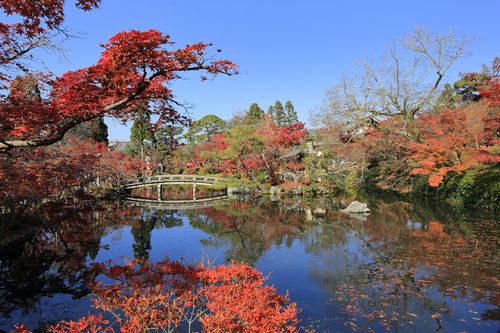
Behind the main buildings spreads the Shinen garden, a stroll garden around ponds created by the seventh Ogawa Jihei (Uetoji), and designated a national Place of Scenic Beauty. It is divided into four gardens, south, west, middle and east, and draws its water from the Lake Biwa Canal. The pillars of the former Sanjo Ohashi and Gojo Ohashi bridges are used in the Garyu Bridge of the middle garden. According to the official website, weeping cherry trees bloom in spring and irises in early summer, and the deciduous trees change their look with each season. The garden is about 10,000 tsubo and the whole precinct about 20,000 tsubo.
Annual observances include the New Year's Day festival, the annual festival and the monthly services, and at the Nagoshi no Oharae a ritual of passing through a ring of reeds is performed. The Jidai Matsuri is also one of the shrine's festivals. The great torii, the vermilion halls and the garden each have a different origin in time, and seeing them overlap within one precinct is part of the pleasure of walking here.
Sources
This article was written from the official, municipal and tourism-association sources above, and checked against them separately from the writing. Editorial policy
Last updated October 29, 2026