ABOUT
About this spot
Higashi Chaya District is a teahouse quarter in Higashiyama, Kanazawa, Ishikawa Prefecture, officially named "Kanazawa-shi Higashiyama Higashi." It is a townscape laid out on the east bank of the Asano River, and on November 14, 2001 it was selected as a nationally designated Important Preservation District for Groups of Traditional Buildings, under the category "teahouse town." It measures about 130 meters north to south and about 180 meters east to west, an area of roughly 1.8 hectares, compact enough to explore on foot. It is one of Kanazawa's leading sightseeing spots.
The origins of the teahouse quarter go back to the Edo period. Kanazawa prospered as a castle town after Maeda Toshiie entered Kanazawa Castle in 1583. The Kaga domain encouraged its people to learn utai, the chanting of Noh texts, and Kanazawa was said to be a place where "utai rains down from the sky." Many teahouses stood around the Sai and Asano rivers near the castle town, and in 1820, with the permission of the Kaga domain, the "Nishi" teahouse quarter was opened on the west side of the Sai River and the "Higashi" teahouse quarter on the east side of the Asano River, and both flourished. At that time the earlier irregular layout was reorganized into orderly blocks. The original division of plots from the founding of the teahouse quarter is still well preserved today.
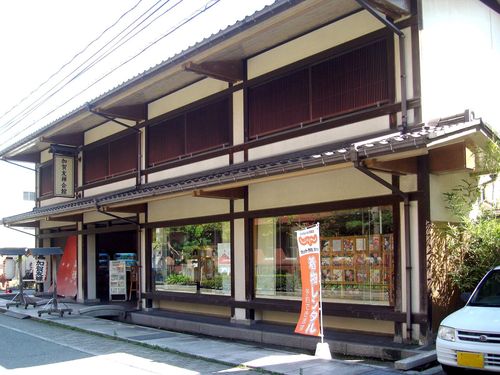
The townhouses are characterized by a projecting lattice (degoshi) on the street-facing first floor and a high-ceilinged second floor holding the guest rooms. This shows how the buildings were used as teahouses, and many teahouse-style townhouses built from the founding of the quarter to the early Meiji era remain. It is rare in Japan for so many teahouse-style townhouses to survive together.
At the heart of the quarter is the teahouse "Shima" on Nibancho Street. It was designated an Important Cultural Property on December 25, 2003 and is open to the public. In the guest rooms on the first and second floors, menpi-bashira (square pillars with the bark surface left on) are used at key points, and the whole interior is richly colored. With red-brown (bengara) earthen walls and metal fittings in representational designs, the interior is distinctive, stylish and gorgeous. It is well preserved and regarded as a typical surviving teahouse building in Higashi, valuable for understanding the commoner culture of the late Edo period.
Along the streets today you will find cafes and shops selling crafts. The row of lattices on high second floors reflects the history of the teahouse quarter just as it was.
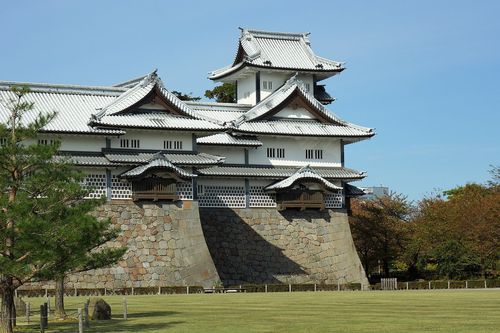
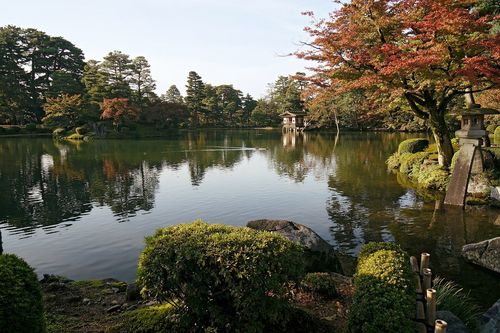
Across the Asano River to the northwest lies Kazuemachi, another teahouse district. If you cross the Asano Ohashi Bridge, you can also walk on to Kanazawa Castle and Kenrokuen. A day might go like this: visit the cafes and shops at midday, see the interior of a teahouse at "Shima," walk the streets in the evening, and then head to Kazuemachi.
The business status of shops and the opening status of Shima can change, so it is wise to check the official information of Kanazawa City or the tourism association before visiting.
Sources
This article was written from the official, municipal and tourism-association sources above, and checked against them separately from the writing. Editorial policy
Last updated November 12, 2026