ABOUT
About this spot
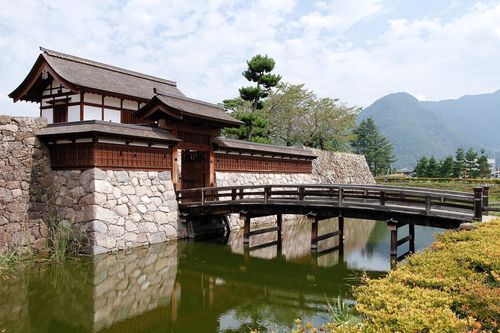
Ueda Castle is a castle site in Ueda, Nagano Prefecture, a flatland castle whose construction was begun by Sanada Masayuki in 1583 (Tensho 11). It faces the Amagafuchi, a branch of the Chikuma River, and in its early days it was sometimes called "Amagafuchi Castle". The Amagafuchi is one of the sights of Ueda Castle Park, and the view of the West Turret across it is well known.
After the Tensho Jingo War, Sanada Masayuki followed Tokugawa Ieyasu but fell out with him over the postwar settlement. In the First Battle of Ueda in 1585 (Tensho 13) he drove back the Tokugawa army, and in the Second Battle of Ueda in 1600 (Keicho 5) he held off the eastern army led by Tokugawa Hidetada. It is known as the castle that repelled the Tokugawa side twice. However, Masayuki and his second son Nobushige, who sided with the western army at Sekigahara, were exiled to Kudoyama in Kii Province, and in 1601 the Tokugawa side tore down Ueda Castle.
Sanada Nobuyuki then took over the Ueda domain but moved to Matsushiro in 1622 (Genna 8). In his place Sengoku Tadamasa, who had moved from the Komoro domain, applied to rebuild the castle, and reconstruction began in 1626 (Kan'ei 3), with seven turrets and two turret gates built in the main enclosure. Because Tadamasa died in 1628, work on the second enclosure stopped partway. The ruling family then changed to the Fujii Matsudaira, and the castle passed into the late Edo period.
The turrets that survive are the south, north and west turrets of the main enclosure, with a black lapped-board exterior of planks waterproofed with soot and persimmon tannin. In 1874 (Meiji 7), all of the seven turrets except the west turret were dismantled and sold. In 1949 the north and south turrets were moved and restored, and in 1994 the East Entrance Turret Gate and its side walls were rebuilt in wood. The three turrets were designated Nagano Prefecture treasures in 1959. At the site of the lord's residence in the third enclosure, the gatehouse and moat of the Matsudaira period remain and are now used as the main gate of Ueda High School.
The moat around the main enclosure is thought to have been filled in once in Masayuki's time and dug out again by the Sengoku family. Excavation of the moat bottom turned up gold-leaf roof tiles, eaves tiles with a chrysanthemum pattern, and fragments of a gold-leaf shachi ornament. Because housing development filled in the moat, the main enclosure is the only part of the castle that survives. Most of the main and second enclosures were designated a national historic site in 1934 (Showa 9), and in 2006 the castle was chosen as one of Japan's Top 100 Castles.
The former second enclosure is now Ueda Castle Ruins Park, with the Ueda City Museum and a shrine for the war dead, among other things. On the site of the main enclosure stands the Sanada Shrine, said to draw many students praying for exams. For the opening of the turret interiors and the state of the park, please check Ueda City's official guidance before you visit.
Sources
This article was written from the official, municipal and tourism-association sources above, and checked against them separately from the writing. Editorial policy
Last updated November 12, 2026