ABOUT
About this spot
Hotaka Shrine has its main shrine in Hotaka, Azumino, an inner shrine (Okumiya) on the shore of Myojin Pond in Kamikochi, and a summit shrine (Minemiya) at the top of Mt. Okuhotaka (3,190 m) in the Northern Alps. Because it has three shrines running from the plain to the mountaintop, it is also called the 'chief guardian of the Japan Alps'. The deity is Hotakami no Mikoto; the left hall of the main shrine honors Watatsumi no Mikoto, regarded as the ancestral god of the Azumi clan, and the right hall honors Ninigi no Mikoto. It is an ancient shrine listed in the Engishiki register as a Myojin Taisha and is counted as the third-ranked shrine of Shinano Province.
The date of its founding is unclear, but it is said to have begun when members of the Azumi clan, who had close ties to the sea, enshrined their ancestral god. An ink inscription of 764 on a hakama preserved in the Shosoin is the earliest record of the Azumi clan in Azumi District. In written sources, a record of 859 raising the shrine's rank from Junior Fifth to Senior Fifth Rank Upper Grade (Nihon Sandai Jitsuroku) is the first mention. In 1582 Ogasawara Sadayoshi, lord of Matsumoto Castle, donated shrine lands.
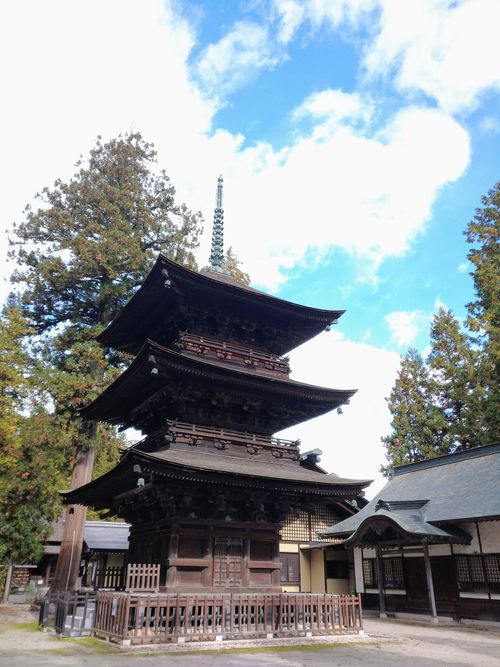
The center of the grounds is the three halls of the main shrine, standing side by side. The middle hall is built in a style called 'Hotaka-zukuri,' topped with chigi and katsuogi; the katsuogi are said to represent a fishing rod or a ship's mast. In front of the worship hall stands the kagura-den, where at the Hoshaisai ceremony on March 17 arrows are shot at a large target hung there to foretell the year's harvest. The Wakamiya enshrines Azumi no Hirafu, and its auxiliary hall enshrines Shinano Chujo, a figure linked to the folk tale Monokusa Taro. Along the approach are an Azumino City-designated shrine bridge, the water basin and its pavilion, and the zelkova tree at Daimon.
The greatest highlight is the Ofune Festival on September 26 and 27 each year. Five boat-shaped floats, large and small, are decorated with Hotaka dolls and pulled through town by parishioners, and the two large boats are rammed against each other before the shrine. September 27 is said to be the death anniversary of Azumi no Hirafu, who is believed to have died at the Battle of Hakusukinoe in 663, and the customs of the festival are an Intangible Folk Cultural Property of Nagano Prefecture. The festival boats and Hotaka dolls can be seen at the Ofune Kaikan on the grounds, which opened in 1982.
At the Okumiya, rites include the mountain-opening on April 27, the main festival (Ofune Shinji) on October 8, and the mountain-closing on November 15. Every 20 years a main hall is rebuilt in the shikinen sengu ceremony, which keeps an old form dating from before 1483.
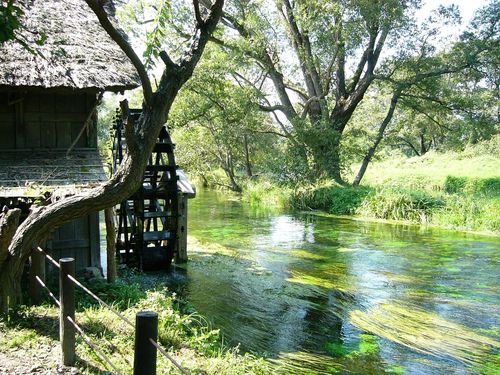
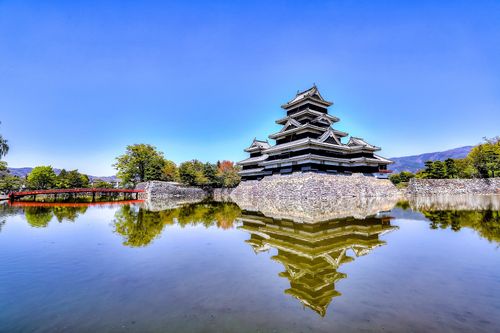
Besides New Year's visits, seasonal events include a chrysanthemum exhibition and Hotaka doll exhibition in November and 'Azumino Kamiakari' bamboo lanterns in December. Allow about an hour for worship and a visit to the Ofune Kaikan. Nearby, the Daio Wasabi Farm makes an easy half-day stroll together with the shrine, and Matsumoto Castle is also within easy reach. It is only about a 3-minute walk from Hotaka Station, so it is easy to stop at during a rail trip.
Sources
This article was written from the official, municipal and tourism-association sources above, and checked against them separately from the writing. Editorial policy
Last updated November 5, 2026