ABOUT
About this spot
Just south of Nijo Castle, on a corner facing Oike-dori, a small precinct built around a pond preserves what is left of an imperial garden from the early days of Heian-kyo. It once lay next to the south side of the Greater Imperial Palace as a vast garden where emperors held banquets and ceremonies. Today it is a temple of the Toji Shingon school with Sho Kannon as its principal image, and the grounds are a National Historic Site.
The garden was laid out by Emperor Kanmu at about the same time as the move of the capital in 794, and he visited it in 800. The 'Hana no En no Setsu' held by Emperor Saga in 812 is thought to be the earliest recorded cherry-blossom viewing. In 824, according to tradition, Kukai of To-ji competed with Shubin of Sai-ji in a rain-making rite, summoned the dragon king Zennyo Ryuo from Lake Anavatapta in India, and won; from then on the garden became a rain-prayer site under To-ji's control. The goryo-e ceremony of 863, and the procession of 869 in which halberds were raised and a portable shrine was brought out from Gion Shrine, are said to be the origin of the Gion Festival.
The great turning point came at the start of the Edo period. When Nijo Castle was built in 1602, most of the northern part of the garden was absorbed into the castle grounds, and the site shrank greatly. The monk Kaiga from Tsukushi then worked to revive it, the temple was granted land income and was put in order as a temple. The Great Tenmei Fire of 1788 destroyed the pagoda and shrine buildings, which were rebuilt over several decades. In 2014, to mark 1,200 years since Zennyo Ryuo was invited here, the pond was drained for the first time in 55 years and the main hall of the Zennyo Ryuo shrine and other structures were dismantled and repaired.
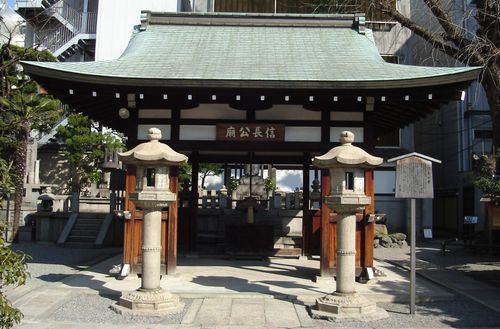
The highlights are the buildings and shrines around the pond. Hojoju Pond is the central pond, said to be home to the dragon god, and the main hall of the Zennyo Ryuo shrine was rebuilt in 1813. The Ehō shrine enshrines Toshitokujin, and every New Year's Eve night the shrine is turned to face the lucky direction of the coming year. The Risho-den was moved from To-ji's Daigensui-do in 1847, and there are also the Kyogen-do built at the end of the Meiji era, the Benten-do enshrining Zoun Benzaiten, and the bell tower built in the early Edo period. Among its cultural properties, a wooden seated statue of Fudo Myoo is designated an Important Cultural Property.
Events run through the year: the Hoshi Matsuri on February 2, Setsubun on February 3, the Shinsen-en Festival on May 2 and 3, and the New Year's Eve direction-changing rite. Since 2014 the Shinsen-en Kyogen has been held in November, normally for three days from the first Friday of the month. The grounds are small, so about 30 minutes is a reasonable visit.
It is usually combined with Nijo Castle (about 317 m away). There is no parking for visitors, though several coin parking lots lie along Omiya-dori to the east. By train, it is about a 3-minute walk from Nijojo-mae Station on the Kyoto Municipal Subway Tozai Line.
Sources
This article was written from the official, municipal and tourism-association sources above, and checked against them separately from the writing. Editorial policy
Last updated November 5, 2026