ABOUT
About this spot
Kozen-ji is a Tendai-sect head temple of special rank (betsukaku honzan) set at the foot of the hills in Komagane. Its mountain name is Hoshakuzan and its sub-temple name is Mudoin; the main image is a hidden statue of Fudo Myoo. Described as the foremost prayer temple in Shinshu, it has drawn deep devotion for centuries. The entire precinct is designated a national Place of Scenic Beauty as the "Kozen-ji Garden," and across roughly 6.7 hectares halls, pagoda, gardens, cedar groves and moss-covered stone walls sit quietly together.
The temple is said to have been founded in 860 by Honsho, a disciple of the monk Ennin. Early records were lost in wars and other upheavals, so the details of its founding remain in the realm of tradition. In the Sengoku period it was protected by the Takeda clan and by Hashiba (Toyotomi Hideyoshi), and in the Edo period Tokugawa Iemitsu granted it a stipend land of 60 koku. More than ten halls and towers still stand on the grounds today.
No account of the temple is complete without the legend of the spirit dog Hayataro. The mountain dog Hayataro, raised at the temple, is said to have defeated a monster that carried off girls in Mitsuke village in Totomi, then returned to the temple and died. His grave is beside the main hall, a stone statue stands in the grounds, and a wooden statue is kept in the hall. The Daihannya sutra offered in memory of Hayataro is stored in the sutra repository.
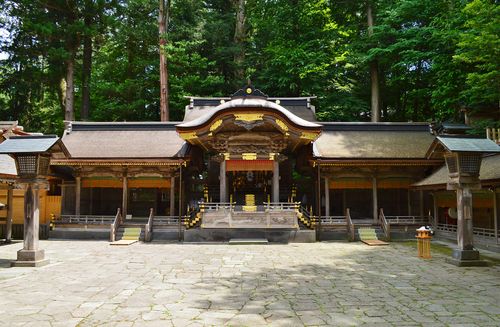
The buildings have much to see as well. The Nio guardian statues at the Nio-mon gate date from 1528 and are a tangible cultural property of Komagane City. The Sanmon gate was rebuilt in 1848, the main hall in 1851, and the sutra repository dates from 1802. The three-story pagoda, about 17 meters tall and rebuilt in 1808, is a Nagano Prefecture treasure. The Benten-do, built in the Muromachi period in the irimoya (hip-and-gable) style, is a national Important Cultural Property.
The garden preserves three styles in one place: a pond garden in the Rankei Doryu style, a mound-and-pond garden and a mound-style dry landscape garden. The stone wall beside the approach is known as a habitat of rare luminous moss (hikarigoke).
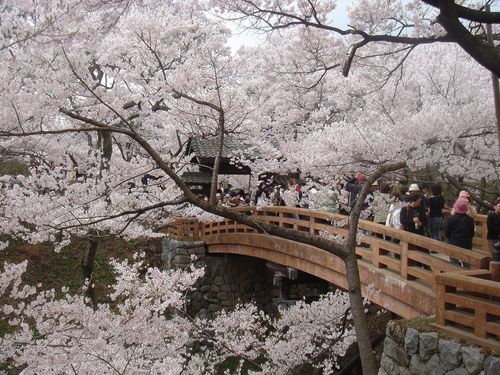
Among the seasons, the weeping cherries, which usually peak from mid to late April, are the signature, followed by azaleas in June and autumn leaves. Annual events include a prayer ceremony against misfortune in mid-January, the first Fudo day on January 28 and the grand festival on April 29. Hours for opening the main hall and viewing the garden can change with the season, so check the official site before you go. Allow about an hour for a relaxed walk.
By car, the temple is a few minutes from Komagane Interchange on the Chuo Expressway, and parking is available. By public transport it is about 4 km west of Komagane Station on the JR Iida Line, or a 10-minute walk from the Kiriishi-koen-shita bus stop. Within Nagano Prefecture, Takato Castle, Narai-juku and Suwa Taisha are other sights you can consider for an itinerary.
Sources
This article was written from the official, municipal and tourism-association sources above, and checked against them separately from the writing. Editorial policy
Last updated November 16, 2026