ABOUT
About this spot
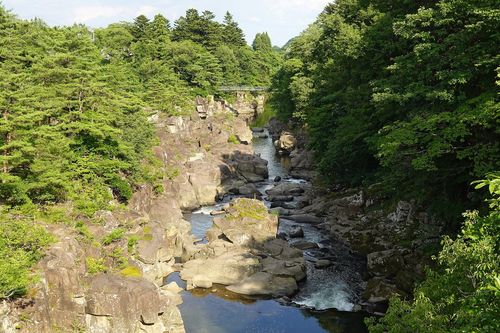
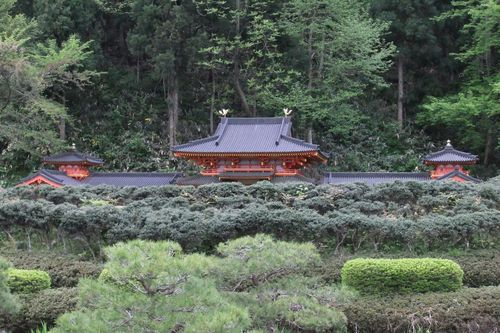
Takkoku no Iwaya Bishamondo is a hall dedicated to Bishamonten built into a rock shelter in a cliff face in Hiraizumi, Iwate Prefecture. About 6 kilometers southwest of Hiraizumi, once the base of the Oshu Fujiwara clan, the precinct of the temple Takkoku Saiko-ji lies at the tip of a ridge, reached by going west up a valley along the Ota River, a tributary of the Kitakami River. A cliff about 150 meters wide east to west, with a maximum height difference of about 35 meters, runs along the west side of the precinct, and in a rock shelter at its base stands the Kutsu Bishamondo, built in the kakezukuri style, raised on supports against the rock. Higher on the cliff face is carved a large rock-face Buddha, said to be either Dainichi Nyorai or Amida Nyorai.
According to tradition, the Bishamondo was built in 801 by the shogun Sakanoue no Tamuramaro to commemorate his defeat of the Emishi leader Akuro-o, who had made this area his base. The earliest appearance in historical records is in the entry for the 28th day of the ninth month of 1189 in the Azuma Kagami, a chronicle of the Kamakura shogunate, which says that Minamoto no Yoritomo stopped at the "Tayagutsu" cave on his way home after destroying Hiraizumi. The same entry says that the Emishi used this rock shelter as a fortress when Tamuramaro attacked, and that Tamuramaro later enshrined a statue of Tamonten there and built a temple hall, naming it Saiko-ji. The shelter is thought to have faced the main road of the time, the Oku-Daido.
The present Kutsu Bishamondo was rebuilt in 1961 after an early modern building burned down in 1946. Saiko-ji serves as the hall's administering temple, and the site preserves a form of worship in which Shinto and Buddhist elements are intermingled.
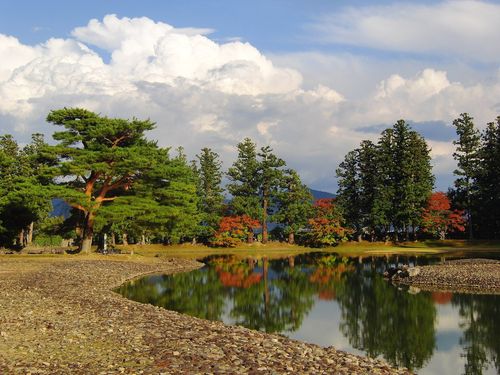
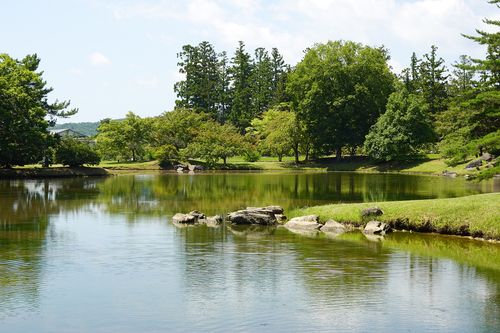
To the south, the pond called Gama-ga-ike has an island with a shrine to Benzaiten. In 1988, an excavation by the Hiraizumi Board of Education found stonework thought to be the pond's embankment and a large number of kawarake, small unglazed dishes. They are dated to the late 12th century, the same period as the Yanagi-no-Gosho site. This suggests the pond dates back to the Fujiwara era and that the layout resembled a Pure Land garden, with a pond in front of a Buddhist hall. Dry moats thought to be medieval strongholds have also been confirmed on the surrounding ridges. In the Middle Ages there were many subsidiary temples, but from the early modern period they declined, leaving only Saiko-ji and its subtemple Kyogakuin.
Takkoku no Iwaya was designated a national historic site on 2 March 2005 as a site essential for understanding religious facilities in Hiraizumi. Before visiting, please check the latest information about access and the grounds with the Bishamondo or the Hiraizumi town office.
Sources
This article was written from the official, municipal and tourism-association sources above, and checked against them separately from the writing. Editorial policy
Last updated November 12, 2026