ABOUT
About this spot
This ancient shrine in Shimonogo, Ueda, Nagano, enshrines two deities as its main gods: Ikushima-no-okami, a god who gives birth to and nurtures all things and bestows vitality, and Tarushima-no-okami, a god who makes the land abundant. The Engishiki register of shrines lists it as "Ikushima Tarushima Jinja, two seats, both great myojin" in Chiisagata District of Shinano Province, and the names of the gods Ikushima and Tarushima also appear among the 23 seats enshrined in the western courtyard of the Department of Divinities at court. It was formerly a Kokuhei Chusha and is now a Beppyo Jinja.
The date of its founding is unclear, but shrine tradition says that Takeminakatatomi-no-mikoto stopped here on his way to Suwa and offered boiled rice porridge to the two gods. In the medieval period it was called Shimonogo Daimyojin and Suwa Hosho Daimyojin, and in 1799 the Yoshida family of Kyoto changed its name to the present one. It was revered by warriors: Hojo Kunitoki repaired the halls, and Sanada Masayuki and Nobuyuki donated shrine lands. The 94 items of Ikushima Tarushima Shrine Documents, a national Important Cultural Property, include oaths submitted by Takeda Shingen's retainers in 1566 and 1567, and Shingen's written prayer also survives.
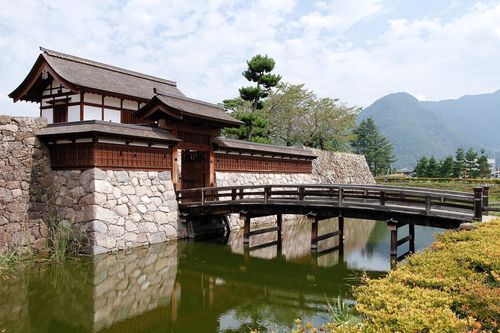
The center of the grounds is the main shrine (the Upper Shrine), facing north on a small island in the pond and known as Chishin-no-miya. The sacred bridge is normally closed and is used only for the procession when the Suwa deity is moved. The inner hall inside the main hall is a gabled structure of thick boards thought to date from the Tenbun era (1522-1555), and the bare earth floor of the inner sanctuary is itself regarded as the object of worship; it is designated a Nagano Prefectural Treasure. The main hall of the auxiliary Suwa Shrine is in the nagare-zukuri style with a single bay, and a ridge tablet shows that it was rebuilt in 1610 with a donation from Sanada Nobuyuki; it is also a Prefectural Treasure. The kabuki stage, nine bays wide and seven deep, is said to be the largest of the village kabuki stages, is said to have been built in 1868, and is also a Prefectural Treasure.
The festivals are varied. At the Onbashira Festival, held every six years in mid-April in the years of the Tiger and the Monkey, the sacred pillars are raised on four sides around the main shrine and Suwa Shrine. Every year the Otsutsugayu Boku-ji divination takes place on January 14, the Shimonogo Sanzu Shishimai lion dance, a municipal intangible folk cultural property, is offered on the last Sunday of July, and the annual festival is held on September 19. In the Ogomori Festival, which runs from the Oiri ritual on November 3 into the following spring, the Suwa deity stays in the main hall and a ritual offering of cooked rice is made once a week.
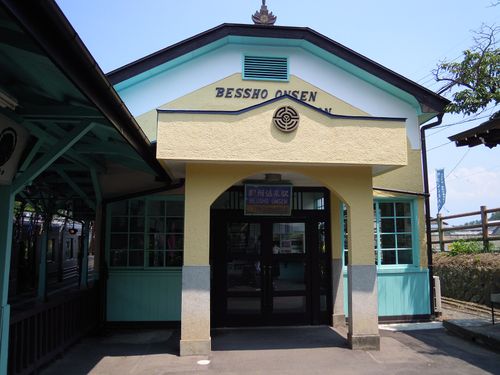
It is easy to reach, about 5 minutes on foot from Shimonogo Station on the Ueda Electric Railway Bessho Line, and 30 minutes to an hour is enough for a relaxed visit. Spending time in front of the bridge and halls reflected in the pond, and the broad kabuki stage, gives a sense of how old this shrine is. It is an easy stop on a trip through the history of Ueda.
Sources
This article was written from the official, municipal and tourism-association sources above, and checked against them separately from the writing. Editorial policy
Last updated November 5, 2026