ABOUT
About this spot
Atsuta Jingu is a Shinto shrine in Atsuta Ward, Nagoya, Aichi Prefecture, historically ranked as a Myojin Taisha and as the third-ranked shrine of Owari Province. The deity enshrined is Atsuta no Okami, said to be Amaterasu Omikami whose spirit-body is the sacred sword Kusanagi, one of the Three Sacred Treasures. Five other deities are enshrined with her: Amaterasu Omikami, Susanoo no Mikoto, Yamato Takeru no Mikoto, Miyazuhime no Mikoto and Takeinadane no Mikoto.
Its origins are bound up with the Kusanagi sword. The sword is said to have been obtained by Susanoo from the serpent Yamata no Orochi and later enshrined by the imperial family; according to tradition Yamato Takeru entrusted it to Miyazuhime, who chose the shrine site at Atsuta. The main theory places its founding in the 43rd year of Emperor Keiko, and a grand ceremony for its 1,900th anniversary was held in 2013, though other theories date its establishment to the first year of Emperor Chuai or to 646. In 668 the theft of the Kusanagi sword was recorded.
From the medieval period the chief priests came from the Owari clan and the Chisaka family of the Fujiwara Nanke line, and the shrine drew national reverence. In the Sengoku period, Oda Nobunaga is said to have stopped here on his way to the Battle of Okehazama and prayed for victory on May 19, 1560. After winning, he is said to have dedicated an earthen wall in thanks, part of which remains as the Nobunaga Wall and is counted among Japan's three great earthen walls. In the Edo period the Miya post station of the Tokaido stood nearby, and many travelers came.
The shrine buildings were constructed in the Shinmei style in 1893, but many were lost in air raids in World War II, and during the war the sacred object was temporarily moved to Minashi Shrine, the first shrine of Hida. The present buildings were rebuilt in 1955 using old timber from Ise Jingu. The main hall is in the Shinmei style, with a copper-plate roof and chigi and katsuogi roof ornaments.
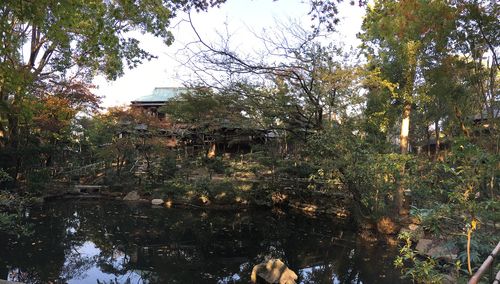
The grounds offer much: the Nobunaga Wall, a giant camphor tree, the treasure hall also called Bunkaden, the nationally registered Ryuei-kaku, the Magatama garden with its pond, the Sakuma lantern, the 25-cho bridge, Kusanagi Square and the Kusanagi-kan, known as the sword treasury. Including the separate shrine Hakken-gu, 45 shrines are enshrined inside and outside the precincts. The collection includes a national treasure dagger by Rai Kunitoshi, important cultural property bugaku masks, ancient sacred treasures and swords, with about 450 blades.
Rituals are held throughout the year, and the largest is the annual festival, the Atsuta Matsuri, in June. The nearest stations are Meitetsu Jingu-mae and JR Atsuta, and although in the city the approach runs through a quiet forest. Facilities and events change with the season, so check official information before visiting.
Sources
This article was written from the official, municipal and tourism-association sources above, and checked against them separately from the writing. Editorial policy
Last updated November 12, 2026