ABOUT
About this spot
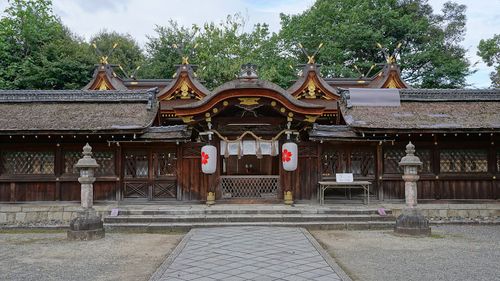
This shrine stands on the former residence of the Asukai family, court nobles who were the hereditary masters of kemari (the ancient court football game) and waka poetry. It lies on Imadegawa-dori, close to the Kyoto Imperial Palace, and enshrines Emperor Sutoku and Emperor Junnin as its main deities. The subsidiary Jishu-sha shrine within the grounds is dedicated to Sei Daimyojin, the guardian deity of kemari, who is now revered by athletes as the guardian of soccer and ball sports in general.
The shrine was founded at the end of the Edo period and the start of the Meiji era. Retired Emperor Sutoku, exiled to Sanuki after the Hogen Rebellion, died there in 1164 (Chokan 2). Near the end of the shogunate, Emperor Komei ordered the shogunate to bring his spirit back to Kyoto, but he died soon afterward. In August 1868 (Keio 4) the founding of Shiramine-gu was proclaimed on the site of the Asukai residence, the retired emperor's spirit arrived in Kyoto in September, and Emperor Meiji paid a visit the next day. In 1873 the spirit of Emperor Junnin, who had died on Awaji Island, was welcomed and enshrined here as well, and in 1940 the shrine became a Kanpei Taisha and took the name Shiramine-jingu.
One highlight of the grounds is Sei Daimyojin, enshrined in the Jinushi-sha. In front of the shrine buildings are balls dedicated by members of Japan's national soccer and volleyball teams, J.League players, and others. At the Spring Grand Festival (Emperor Junnin Festival) on April 14 and the Sei Daimyojin Festival on July 7 each year, the Kemari Preservation Society performs kemari as an offering, passing down a pastime of the Heian aristocracy. A kemari monument also stands in the grounds, and the good-luck charm "Kanau-wa" is popular.
The main hall is in the nagare-zukuri style with a copper-plate roof, modeled on the main hall of Kawai Shrine, an auxiliary shrine of Shimogamo Shrine. At the hand-washing pavilion, clear water wells up from "Asukai," a famous spring named for the Asukai family. The "Ogatama no ki" tree in the grounds is a natural monument designated by Kyoto City and is said to be 800 years old. Among the auxiliary shrines is Tomoo-sha (founded in 1878), which enshrines Minamoto no Tameyoshi and Tametomo and is revered as a shrine of martial arts. There is also Senryu-sha, which enshrines three dragon deities said to have appeared at the Ohitaki festival of 1955. The shrine's "Portrait of Retired Emperor Sutoku, color on silk" (with two attendant portraits) is designated an Important Cultural Property.
Events fill the year: the Setsubun festival in February, the Nagoshi Purification (passing through the ring of reeds) on June 30, the Tanabata festival on July 7 (Yamashiro bugaku, kemari, and Komachi dance), the Emperor Sutoku Festival on September 21 (Noh by firelight), the Tomoo-sha Festival on November 15 (a sacred archery rite), and the harvest festival and Ohitaki on November 23.
You can walk around the grounds in about 30 minutes and worship in a quiet atmosphere. Combined with the nearby Kyoto Imperial Palace, it suits a day of shrines and temples in Kamigyo.
Sources
This article was written from the official, municipal and tourism-association sources above, and checked against them separately from the writing. Editorial policy
Last updated November 5, 2026