ABOUT
About this spot
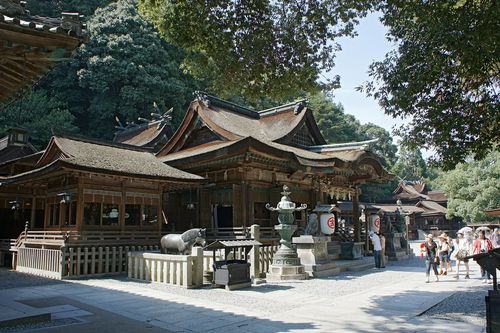
Zentsuji, in Zentsuji City, Kagawa Prefecture, is the head temple of the Shingon Zentsuji school and bears the full name Byobugaura Gogakusan Tanjo-in Zentsuji. It is regarded as the birthplace of Kukai (Kobo Daishi), and together with To-ji in Kyoto and Koyasan in Wakayama it is counted as one of the three great sacred sites of Kobo Daishi. It is also Temple No. 75 of the 88-temple Shikoku pilgrimage.
The mountain name, Gogakusan, comes from the five peaks that rise west of the temple: Kojikizan, Hitsuzan, Gahaishizan, Chuzan and Kajozan. Because the peaks stand in a row like a folding screen, the area was once also called Byobugaura ("folding-screen shore"). The name Tanjo-in, "birth hall," marks the place as the birthplace of the Daishi.
Its founding is told in a record compiled in the mid-Edo period. According to it, Kukai, returned from Tang China, built the temple on land of four chō square donated by his father, modeling it on Qinglong Temple in Chang'an, where his teacher Huiguo (Keika in Japanese) had lived. Ground was broken in 807, the temple was completed in the sixth month of 813, and it took its name from his father's name, Zentsu. In the Kamakura period a hall called Tanjo-in was built on the site of the residence of the Saeki family, Kukai's family. Until the Edo period Zentsuji and Tanjo-in each had its own abbot, but in the Meiji era they became one temple.
The grounds, about 45,000 square meters, are divided into two compounds, east and west. The eastern compound, called the garan, is the original temple precinct and holds the main hall and the five-story pagoda. The original buildings burned in a battle fire in 1558, but rebuilding went ahead with the help of the Ikoma and Kyogoku families and others. The main hall was rebuilt in 1699 and its principal image is a seated Yakushi Nyorai. The pagoda is the fourth, completed in 1902, and stands 43 meters high. Both the main hall and the pagoda are designated Important Cultural Properties.
The western compound, Tanjo-in, centers on the Mieido (Founder's Hall). It stands where the Saeki residence was, and the hall's inner sanctuary is said to occupy the spot of the mother's room. The kaidan-meguri is a dark passage walked as spiritual practice to look within oneself, and its center lies directly beneath the inner sanctuary. Visitors can also see the birth-water well and a treasure hall that houses the temple's treasures, among them the National Treasures of a gilt-bronze monk's staff head and the introductory chapter of the Lotus Sutra copied with a Buddha image for each character.
The grounds are designated a national historic site as the Sanuki pilgrimage route. Zentsuji City's website also introduces the Arioka tumuli cluster, the former Kaikosha (an army officers' club) and the city tourist exchange center.
Buildings such as the Mieido, the Niomon gate and the Shakado hall were each rebuilt at different times, so walking between the two compounds shows how the precinct developed. The timing of ceremonies and special viewings, and the reception for the treasure hall and the kaidan-meguri, can change, so check the official website before you go.
Sources
This article was written from the official, municipal and tourism-association sources above, and checked against them separately from the writing. Editorial policy
Last updated November 12, 2026