ABOUT
About this spot
Fushimi Inari Taisha stands at the western foot of Mt. Inari, the southernmost peak of the Higashiyama range that frames the eastern side of the Kyoto basin. It is the head shrine of the roughly 30,000 Inari shrines said to exist across Japan, and enshrines Inari Okami, including Ukanomitama no Okami. Worship here is said to have begun with the veneration of the mountain's three peaks as deities themselves, and the whole mountain has long been treated as the sacred body of the god. The shrine is revered for a good harvest, business prosperity, family safety, and the fulfilment of wishes, and still draws worshippers from all over the country.
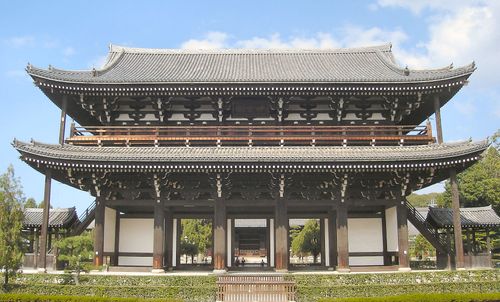
According to the shrine's own tradition, the deity was enshrined on Mt. Inari on the day of the first horse of February in the fourth year of Wado (711), in the Nara period, and 2011 marked the 1,300th anniversary. In the Heian period the shrine became the guardian shrine of To-ji and was linked with Shingon esoteric Buddhism. It appears as a Myojin Taisha in the Engishiki Jinmyocho of 927, and is counted among the upper seven of the Twenty-Two Shrines. It is said to have been granted the highest rank, Shoichii, in 942. The Pillow Book includes a scene in which Sei Shonagon envies a woman who visits many times on the day of the first horse, showing how beloved the shrine already was. After the buildings, including those on the mountain, burned in the Onin War, the deity was re-enshrined in 1499, and in 1589 Toyotomi Hideyoshi rebuilt the two-story gate.
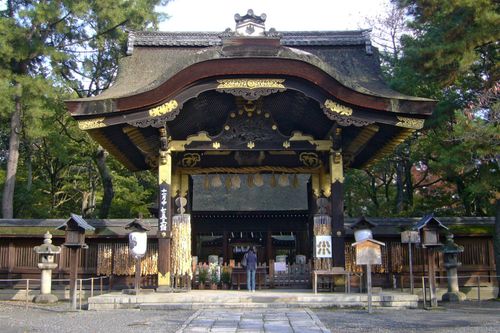
In the precinct at the foot of the mountain stand buildings designated as Important Cultural Properties, including the main hall rebuilt in 1499 (a five-bay nagare-zukuri structure with a cypress-bark roof), the outer worship hall, the Gonden, the gate, the north and south corridors, and the Okumiya. Iron lanterns hung under the eaves of the outer worship hall carry openwork designs of the twelve zodiac signs. The Byakko-sha, dedicated to the white foxes that serve Inari, is the only shrine in the precinct that enshrines these messengers. Inside the gate stands the former residence of the scholar Kada no Azumamaro, a nationally designated historic site.
Beyond the main hall, the path onto Mt. Inari leads into the Senbon Torii, a tunnel of vermilion gates set closely together. The custom of donating a torii in thanks for a granted wish is said to have spread in the Edo period, and the mountain is said to hold about 10,000 of them. The red color is regarded as a protection against evil. The mountain rises to 233 meters, with the first, second, and third peaks in a row, each marked by a sacred site. Countless small shrines called otsuka, with stone monuments inscribed with divine names, create a distinctive landscape. Beyond the Okusha Hohaisho is the Omokaru-ishi, a stone you lift while holding a wish in mind; if it feels lighter than expected, the wish is said to come true.
Each year the Hatsuuma Taisai is held on the day of the first horse in February, and the shrine has long been crowded then. A walk around Mt. Inari takes considerable stamina and time, so you can turn back whenever you wish. Worship etiquette and conditions in the precinct can change, so please check the official website before you visit.
Sources
This article was written from the official, municipal and tourism-association sources above, and checked against them separately from the writing. Editorial policy
Last updated November 12, 2026