ABOUT
About this spot
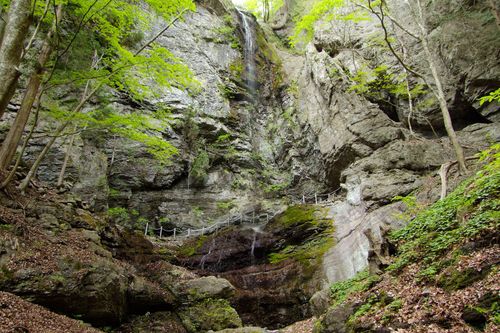
Sanbaseki Gorge is a stretch of about 1.5 km on the Kanna River, which flows along the border of Gunma and Saitama prefectures, just below Shimokubo Dam. The right (south) bank belongs to Kamikawa in Saitama and the left (north) bank to Fujioka in Gunma, and both banks form cliffs of around ten meters. It was designated a national Place of Scenic Beauty and Natural Monument on July 3, 1957. Sources give its length as anywhere from 1.3 to 2 km.
The star of the valley is the Sanba stone that gives it its name. It is a bluish green schist in which quartz, washed by the water, stands out as white veins. This area is the type locality of the Sanbagawa metamorphic belt, regarded as Japan's largest regional metamorphic belt, and the name goes back to 1888, when Koto Bunjiro named the crystalline schist he found at Sanbagawa "Sanbagawa crystalline schist." The green color is explained by chlorite and epidote, and the white stripes by quartz.
Sanba stone has long been prized as garden stone. A document from the Kan'ei era (1624-1645) records its collection, and it is thought to have been known as garden stone by the early Edo period. Its resistance to fading is also given as a reason it suits gardens. After the designation, quarrying in the designated area was banned, but dealers in garden stone and landscaping gathered in the area, numbering 550, and it is regarded as the largest center of the garden stone trade in eastern Japan.
The gorge is lined with the "Forty-eight Sanba Stones," known since the Edo period, each with its own name. There are 48 stones, from "Ichiban-ishi" (Stone No. 1) near Tosen Bridge on Prefectural Route 331 to "Amida-ishi" near the discharge outlet of Shimokubo Dam, and Fujioka's guide also mentions one called "Fune-ishi" (Boat Stone). The 1872 gazetteer Kozuke no Kuni Gunsonshi describes the gorge as "a wonder of the district." Theories on the origin of the name include that rocks No. 1 to No. 3 are lined up in the shape of a wave, that the rock has three colors of green, yellow, and white, and that veins of quartz trace a wave pattern.
The gorge changed greatly when Shimokubo Dam was completed in 1968. Almost no water flowed through it, and the rocks became dirty with algae and dust. For that reason, releases of water began in 2001 as a water-environment improvement project, and since 2003 sediment flushing has also been carried out, with the aim of, among other things, polishing the rocks and restoring their green surface. Seen as a landscape maintained by human effort, it offers a different kind of appeal.
The best time is usually the autumn leaves from late October to early November, and the fresh green and the green reflected on the water are also known. A visitor parking lot is on the Fujioka side, and you can walk the promenade looking at the rocks. Because some paths, such as parts of the boardwalk, are sometimes closed, it is wise to check with the Fujioka Onishi Branch Office before you go.
Nearby is Nagatoro Gorge in Saitama, which belongs to the same Sanbagawa metamorphic belt, so you can plan a day trip combining valleys. By car, about 35 minutes from Honjo-Kodama IC on the Kan-etsu Expressway is a good guide.
Sources
This article was written from the official, municipal and tourism-association sources above, and checked against them separately from the writing. Editorial policy
Last updated November 16, 2026