ABOUT
About this spot
Here the Ono River spreads out and drops as a curtain of water about 100 meters wide. The Odaki (male falls) on the main stream is about 20 meters high, and the Medaki (female falls) on the Hirai River, a tributary joining just downstream, is about 18 meters high and 4 meters wide. Together they are called Chinda Falls. The Odaki has a distinctive look, with columnar-jointed rock jutting out and standing in rows like pillars, which is why it is also called the "Niagara of Ono." It was designated a nationally registered monument in 2007.
The falls were shaped by volcanic activity at Aso. An eruption of Aso about 90,000 years ago is said to have filled the valley, and later erosion carved the present terrain. The orderly columnar joints of the Odaki tell the story of a landscape that began with that eruption.
The site is also well known historically. It is said that in 1476 the painter Sesshu visited and made the ink painting "Chinda Taki-zu." The original was lost in the Great Kanto Earthquake, but a copy by Kano Tsunenobu survives at the Kyoto National Museum. The Edo-period gazetteer "Bungo Kokushi" also describes the place and notes that the depth of the pool cannot be measured. There is also a tradition that in the Oka domain, a defendant was thrown into the pool below the falls and freed if he survived, and the site of that execution ground remains nearby.
Its modern history is worth seeing too. A hydroelectric power station was built in 1909 and a weir was built above the Odaki. Raising the weir in 1923 diverted more water, and the falls lost their former force, but reinforcement work on the weir that began in 1996 allowed a steady flow again and restored the scenery. Between the Odaki and the Medaki remain the stone-built power station ruins, so natural scenery and industrial heritage can be seen together.
There are two viewing bases: Chinda Falls Fureai Park and Takimi Park. A walking path runs from Fureai Park to the edge of the Odaki, and the observation deck at Takimi Park looks across to the Medaki. Allow about an hour even if you take time for photographs. By car, the falls are about 38 kilometers from Oita-Miyagochi IC on the Higashi-Kyushu Expressway; by train, it is about a 35-minute walk from Bungo-Kiyokawa Station on the JR Hohi Line (about 10 minutes by taxi).
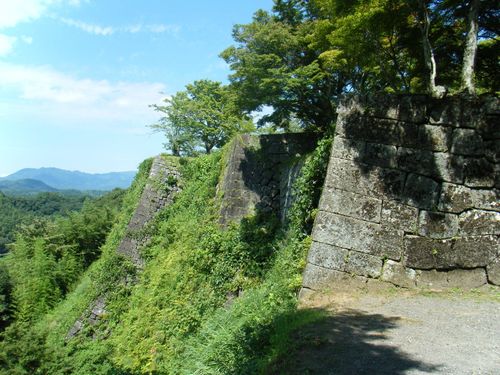
Nearby are Harajiri Falls, the horseshoe-shaped falls known as the "Niagara of the East," the ruins of Oka Castle, the seat of the Oka domain, and Taizako Gorge, with welded tuff cliffs about 70 meters high. It is an easy stop on a tour of the waterfalls and gorges of Bungo-ono.
Sources
This article was written from the official, municipal and tourism-association sources above, and checked against them separately from the writing. Editorial policy
Last updated November 15, 2026