ABOUT
About this spot
Ginkaku-ji, formally Higashiyama Jisho-ji, is a Rinzai-sect temple of the Shokoku-ji school in Sakyo Ward, Kyoto. It is a sub-temple of Shokoku-ji located outside its precincts, and its principal image is Shakyamuni. The official site also introduces it as one of Shokoku-ji's sub-temples. In 1994 it was inscribed on the UNESCO World Heritage list as part of "Historic Monuments of Ancient Kyoto."
The temple began when Ashikaga Yoshimasa, the eighth Muromachi shogun, started building a villa in the Higashiyama hills. Work is said to have begun in 1482 (Bunmei 14), and after Yoshimasa's death in 1490 (Entoku 2) it became a Zen temple, taking the name Jisho-ji the following year. The villa is said to have been modeled on Saiho-ji, the "Moss Temple." Muso Soseki is named as founder, but he actually lived about a century before its foundation and was invoked later as a nominal founding priest. During the Sengoku period most of the halls were lost in fighting connected with the building of Nakao Castle, leaving only the Silver Pavilion and Togudo.
The center of the grounds is the Kannon-den, popularly the "Silver Pavilion" (Ginkaku). This two-story pavilion, whose frame was raised in 1489 (Chokyo 3), is a National Treasure. Its roof is shingled with thin wooden boards, and a bronze phoenix stands at the peak. Together with the Golden Pavilion and Hiunkaku of Nishi Hongan-ji, it is called one of Kyoto's three pavilions. It is said to have been modeled on the Golden Pavilion, but it was never covered in silver leaf, as a 2007 scientific survey also confirmed. The name "Ginkaku" spread only from the Edo period on.
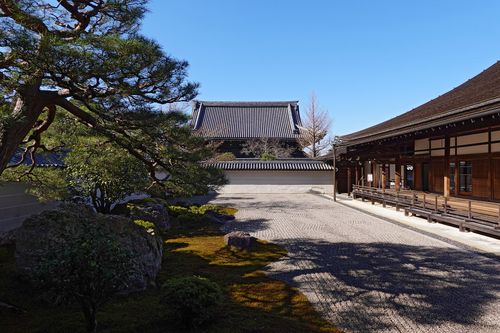
The other National Treasure is the Togudo, a private Buddha hall built in 1486 (Bunmei 18). One room, the Dojinsai, is a four-and-a-half-mat study that retains a desk-window and staggered shelves regarded as a source of the shoin style, and it is traditionally said to be the origin of the four-and-a-half-mat tea room. It is considered important for understanding the aesthetics of Japanese dwellings and the tea ceremony.
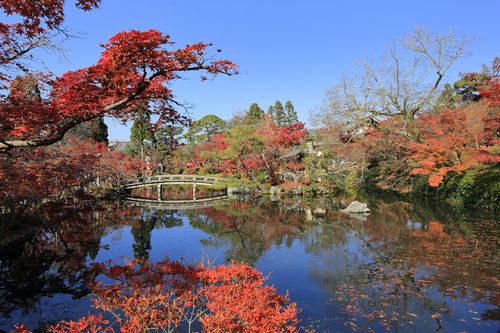
The garden is a strolling pond garden centered on Kinkyo Pond, designated a Special Historic Site and Special Place of Scenic Beauty in 1952. The white-sand Ginshadan and the cone-shaped Kogetsudai are said to have taken their present shape in the late Edo period. Walking the path around the pond lets you see the Silver Pavilion from slightly different angles.
The Silver Pavilion underwent major restoration from 2008 to 2010, including roof re-thatching and seismic reinforcement; the roof is renewed about every thirty years. Check the official site for what is open and any visiting guidance before you go.
Sources
This article was written from the official, municipal and tourism-association sources above, and checked against them separately from the writing. Editorial policy
Last updated November 12, 2026