ABOUT
About this spot
The old townscape of Takayama refers to the Takayama Sanmachi ("Three Towns") Preservation District for Groups of Traditional Buildings, which spreads out on the east side of the Miya River in the center of Takayama, Gifu Prefecture. It spans Kami-ichinomachi, Kami-ninomachi and Kami-sannomachi, plus parts of Kataharamachi and Shinmeimachi 4-chome, measuring about 420 m north to south and about 150 m east to west, with an area of about 4.4 ha. It is commonly called Sanmachi-dori, was selected as a National Important Preservation District for Groups of Traditional Buildings in February 1979, and its area was expanded in 1997.
The town's origins go back to its days as a castle town. Kanamori Nagachika, who pacified Hida on the orders of Toyotomi Hideyoshi, built the castle town, and a merchants' quarter was created within it. The layout placed samurai residences on the higher ground surrounding the castle and the townspeople's quarter on a lower level, and the townspeople's area was set at about 1.2 times the size of the samurai area. This reflects the Kanamori clan's emphasis on the economic strength of merchants. Even after Takayama became a direct shogunate territory in 1692 (Genroku 5), the former castle town thrived as the townspeople's district and the commercial center of Hida.
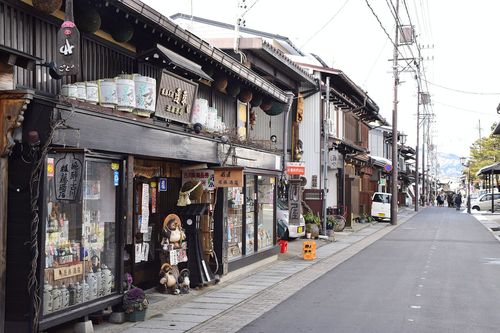
The characteristic buildings are machiya townhouses in which the room facing the street is called the "mise." They have a narrow frontage of three to four ken and a deep floor plan,. Many Japanese-style buildings from the Edo period to the Meiji period remain, and the bengara-red lattice windows and gofun-white brackets convey the look of the era when the town flourished as a merchants' town. Large buildings such as sake breweries, with frontages of 14 ken, were not rebuilt, and the surrounding buildings were kept in line with them, which is said to be how the townscape survived.
Residents' efforts also helped protect the townscape. As the Miya River grew polluted, a citizens' movement spread after children released carp into the river. In 1966 (Showa 41) the Kami-sannomachi Townscape Preservation Society was formed, and its members voluntarily agreed that when rebuilding or building new houses they would at least make the front fit the townscape. A survey by the Nara National Research Institute for Cultural Properties in 1973 and 1974 led to the national selection.
Within the Sanmachi district there are sights such as the Fujii Folk Art Museum (Fujii Bijutsu Mingeikan) and the Takayama City Memorial Hall (Takayama Shisei Kinenkan). The Shimo-ninomachi and Oshinmachi district to the north was also added as a preservation district in 2004 (Heisei 16). The four preservation societies in the district continue, on their own initiative, to hold study trips, fire drills for their volunteer fire brigades and discussions on townscape preservation.
Sources
This article was written from the official, municipal and tourism-association sources above, and checked against them separately from the writing. Editorial policy
Last updated November 12, 2026