ABOUT
About this spot
Jingo-ji is an old mountain temple on the slopes of Mount Takao, in the hills northwest of central Kyoto, with its halls overlooking the valley of the Kiyotaki River. Its formal name is Takaosan Jingo Kokuso Shingon-ji, and it is a head temple of the Koyasan Shingon school. The principal image, a standing wooden Yakushi Nyorai, is a National Treasure, and the temple is the 44th stop on the Saigoku Yakushi 49 pilgrimage. It is one of the three temples known as Sanbi, a famous autumn-leaf area, and has long been valued for its ties to both Kukai and Saicho.
The temple grew out of two earlier temples associated with Wake no Kiyomaro: Jingan-ji and Takaosan-ji. At Takaosan-ji, Saicho held a Hokke-e lecture in 802, and in 812 Kukai stayed here and conducted a kanjo initiation. In 824 an order from the Council of State exchanged and merged the two temple sites, creating Jingo Kokuso Shingon-ji. Fires in 994 and 1149 left it in decline, but in 1168 the monk Mongaku began its revival, and the temple recovered enough that Retired Emperor Go-Shirakawa made a visit. After the whole complex burned in the Tenbun era (1532-1555), buildings such as the Bishamon-do were rebuilt in 1623 under Itakura Katsushige, the Kyoto deputy, and in 1935 the businessman Yamaguchi Gendo donated funds that completed the Kondo and the Tahoto pagoda.
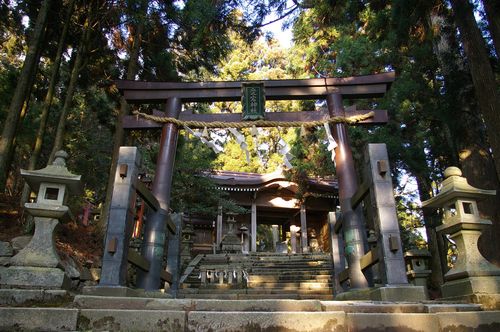
The approach climbs stone steps up from the Kiyotaki River valley. The entrance gate, the Romon, was rebuilt in 1629 and is designated by Kyoto Prefecture. The Yakushi Nyorai in the Kondo is carved from a single block of kaya wood in the early Heian period, a National Treasure with a powerful face left in plain unpainted wood; the hall itself dates from the 1935 rebuilding. The Tahoto houses the National Treasure statues of the Five Great Kokuzo Bosatsu. The Daishi-do is an Important Cultural Property that enshrines a carved wooden image of Kobo Daishi made in 1302. The Bishamon-do and the Godai-do were both built in 1623 and are prefectural cultural properties.
The temple's treasures include many National Treasures: the Takao Mandala (the Ryokai mandalas in gold and silver on purple silk), which preserves Tang-style work from Kukai's lifetime; the bell known as Sanzetsu no Kane, cast in 875; and the Kanjo Rekimei, the list of initiates that Kukai wrote in his own hand. Many of these treasures are kept on deposit at institutions such as the Kyoto National Museum. In front of the Jizo-in, visitors can throw small unglazed dishes called kawarake into the Kinun Valley, a custom said to have begun at Jingo-ji to ward off misfortune.
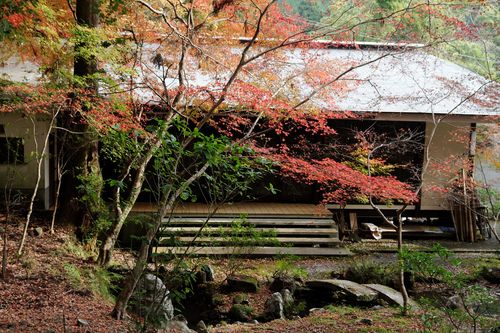
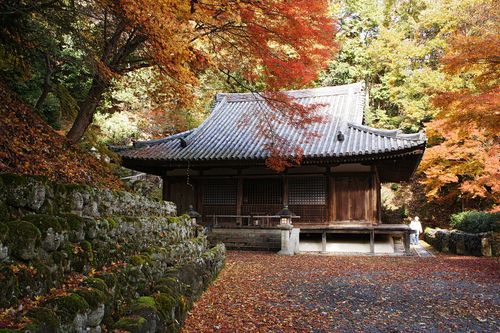
The autumn leaves usually peak from mid to late November. Fresh green and the deep green of the maples in summer are also beautiful, and the mountain is calm. There is a walk from the bus stop to the foot of the approach, then the stone steps, and the grounds themselves are uneven, so wear comfortable shoes and allow plenty of time. Nearby are Kozan-ji (Togano-o) and Saimyo-ji (Makino-o), the other two of the Sanbi temples, and Daikaku-ji in Sagano; visiting them together gives a fuller sense of the mountain temples of northern Kyoto.
Sources
This article was written from the official, municipal and tourism-association sources above, and checked against them separately from the writing. Editorial policy
Last updated November 12, 2026