SPOT

Iwakuni Castle

A mountain castle in the Momoyama-style "Nanban-zukuri," the symbol of Iwakuni City in Yamaguchi Prefecture and counted among Japan's 100 Famous Castles. From the keep you can see the castle town, Kintai Bridge, and the Seto Inland Sea.

YamaguchiIwakuni City

34.18°N 132.17°E

TRAVEL NOTES

Before you visit Iwakuni Castle

How long does a visit to Iwakuni Castle take?
Visiting Kintaikyo Bridge, the Iwakuni Castle Ropeway and Iwakuni Castle together takes about 1.5 to 2 hours.Source: Iwakuni City Tourism Promotion Division
When is the best time to visit Iwakuni Castle?
Autumn leaves around Kintaikyo Bridge, where Iwakuni Castle stands, are usually at their best from mid to late November.Source: Yamaguchi Prefecture Tourism Federation

Checked against official information on November 14, 2026. Please see the official website for the latest details.

ABOUT

About this spot

Iwakuni Castle is a hilltop castle built on the summit of Mt. Yokoyama in Iwakuni, Yamaguchi Prefecture, almost encircled by the winding Nishiki River. After the Battle of Sekigahara, Mori Terumoto was moved from Hiroshima Castle to Hagi Castle in 1600, and his kinsman Kikkawa Hiroie was granted this land with a 30,000-koku domain. He arrived the following year and began construction, completing the residence "Doi" at the foot of the hill in 1602 and Yokoyama Castle on the summit in 1608. A four-tier, six-story keep in the karazukuri style was built on the main enclosure.

Only seven years after completion, in 1615, the shogunate's one-castle-per-province order led to the demolition of the hilltop castle. Iwakuni was the only castle in Suo Province, but because Mori Hidemoto of Chofu had already dismantled his own castle, Kushizaki Castle, it is explained that Iwakuni had little choice but to follow. The keep base was also demolished in the process, yet about a quarter of it remained underground. The residence at the foot of the hill then served as the administrative headquarters of the Iwakuni domain until the Meiji Restoration. For a long time the domain was not recognized as an independent branch domain; it became one only in 1868, just three years before the abolition of domains.

The present keep is a reinforced-concrete reconstruction whose exterior was restored in 1962. It is a four-tier, six-story Momoyama-style nanbanzukuri keep, a style in which the top floor projects beyond the floor below and the roof between them is omitted. When it was rebuilt, it was placed to the south of the original main enclosure so that it would be easier to see from Kintai Bridge. Swords, weapons and armor are displayed inside the keep. On the hilltop remain the old-style anozumi stone walls excavated and restored in 1995, as well as stone walls and dry moats of the Kita-no-maru enclosure.

The site of the old residence at the foot of the hill is now Kikko Park. The park has Kinunkaku, an ema hall built in 1885 in imitation of a turret of the domain era, and the long house of Shomeikan, built in the Kansei era (1789-1800), still survives. The hilltop and the foot of the hill are linked by the Iwakuni Castle Ropeway. Below the castle spans Kintai Bridge over the Nishiki River, and the castle town was laid out along the line of this bridge.

Iwakuni Castle was selected as No. 74 of the Japan's Top 100 Castles in 2006. Please check official information before you visit.

Sources

  1. ja.wikipedia.org
  2. iwakuni-kanko.com

This article was written from the official, municipal and tourism-association sources above, and checked against them separately from the writing. Editorial policy

Last updated November 16, 2026
Share this spot

NEARBY

Nearby recommendations

More places worth visiting in the area.

Iwakuni City, Yamaguchi

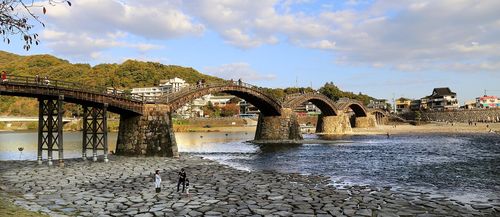
Kintai Bridge

Kintai Bridge is a wooden bridge over the Nishiki River in Iwakuni, Yamaguchi. It has five spans, with three arches in the middle and a girder span at each end, and is about 200 m long.

Yanai City, Yamaguchi

Yanai Shirakabe Townscape

Yanai Shirakabe Townscape is a merchant town preserved in Yanai, Yamaguchi. Selected as a Preservation District for Groups of Traditional Buildings in 1984, it has white-walled houses along a stone-paved street for about 200 m.

Hofu City, Yamaguchi

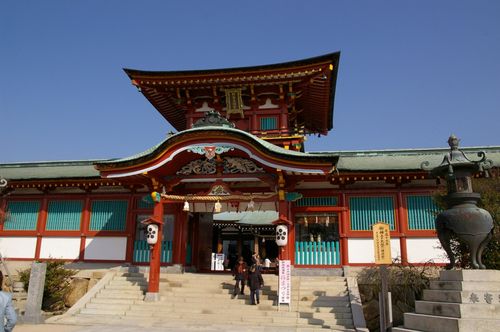
Hofu Tenmangu Shrine

The first Tenjin shrine ever founded in Japan. Dedicated to Sugawara no Michizane, the god of learning, it is one of Japan's three great Tenjin shrines and welcomes many worshippers throughout the year.

Yamaguchi City, Yamaguchi

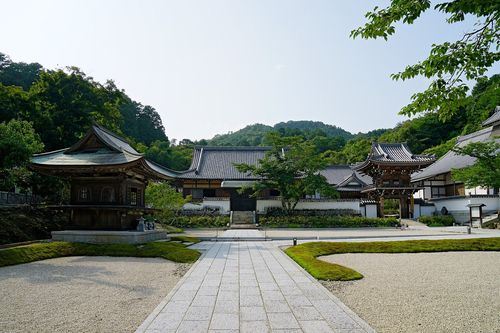
Joei-ji Temple (Sesshu Garden)

A Japanese garden said to have been created by the master painter Sesshu in the Muromachi period. A nationally designated Historic Site and Place of Scenic Beauty, charming for its stonework that embodies the world of ink painting and its seasonal beauty.

Yamaguchi City, Yamaguchi

Yamaguchi Xavier Memorial Church

Yamaguchi Xavier Memorial Church is a Catholic church on Kameyama in Yamaguchi, marked by two tall towers. Built to commemorate Francis Xavier’s mission here, the present church was completed in 1998.

Yamaguchi City, Yamaguchi

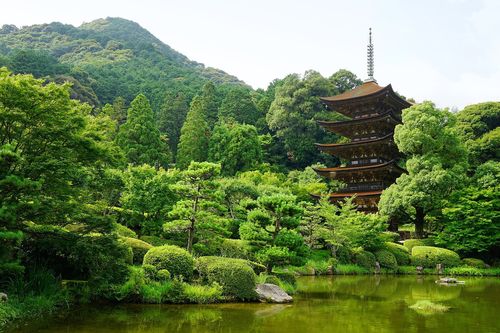
Rurikoji Temple

Rurikoji Temple stands in Kozan Park in Yamaguchi and is known for its National Treasure five-story pagoda, a legacy of Muromachi-period Ouchi culture. The 31.2 m pagoda is in the wayo style with Zen-style elements.

AREA

Explore the area

More places in the same city, the same category, and close by.

NEARBY

Festivals and breweries in Iwakuni City

Festivals and brewery visits on our sister sites, in the same city as this spot.

MORE TO EXPLORE

More from Yamaguchi

Discover more of the same region on our sister sites.